Home Stretch

image

We like to tent close together …

Funny how I never feel more at home than when I’m leaving it. Or at least leaving (for me) the emotionally complicated confines of Southern California, where this minor character was born and raised. Preferably by my dear old escape route: Highway 1 North along the coast.

Friday had been a desperate dash west from southern Utah, shedding clothes, crossing the desert — followed by a wonderful weekend with SoCal friends and family. A resupply at REI. A last sentimental glance at the old family home … then onward and upward, compass wise.

Highway 1 from Long Beach to Santa Monica is a jungle of stop lights, so it makes more sense to take the 405-North around it. But that meant briefly joining L.A. commuters in their early Monday morning freeway traffic, which inevitably rolls to a standstill, even in the carpoolers’ express lane, where motorcyclists are welcome.

When that happens, California law allows motorbikes to “thread the needle” between lanes. I’ve always been reluctant to join in, suspicious that some large vehicle might suddenly decide to change lanes and take me with it. But the double-yellow line between the express lane and the lane to the right (which theoretically prevents cars from crossing it until the next exit) beckoned. And after about 15 minutes at 5 mph, I joined the other needle-threaders at 25.

Once you reach the coast in Santa Monica, however, everything changes. All the Malibu bunch heading south and east to work are bumper to bumper, while you, heading north, enjoy a free and open road, and the sky is blue and the sun shines. I’ve always felt better traveling from Santa Monica to Santa Barbara to San Luis Obispo. But once I get north of Morro Bay, the real magic happens. Especially in the off-season months of April or October. Especially on a motorcycle.

There’s a campsite I like in San Simeon. Then a beach further north where elephant seals haul out after their long migration from the Gulf of Alaska. Then comes the gently undulating rise and fall of the Big Sur country, the loveliest road I know …

This slideshow requires JavaScript.

Posted in Road Trip | 2 Comments

Rock-solid service

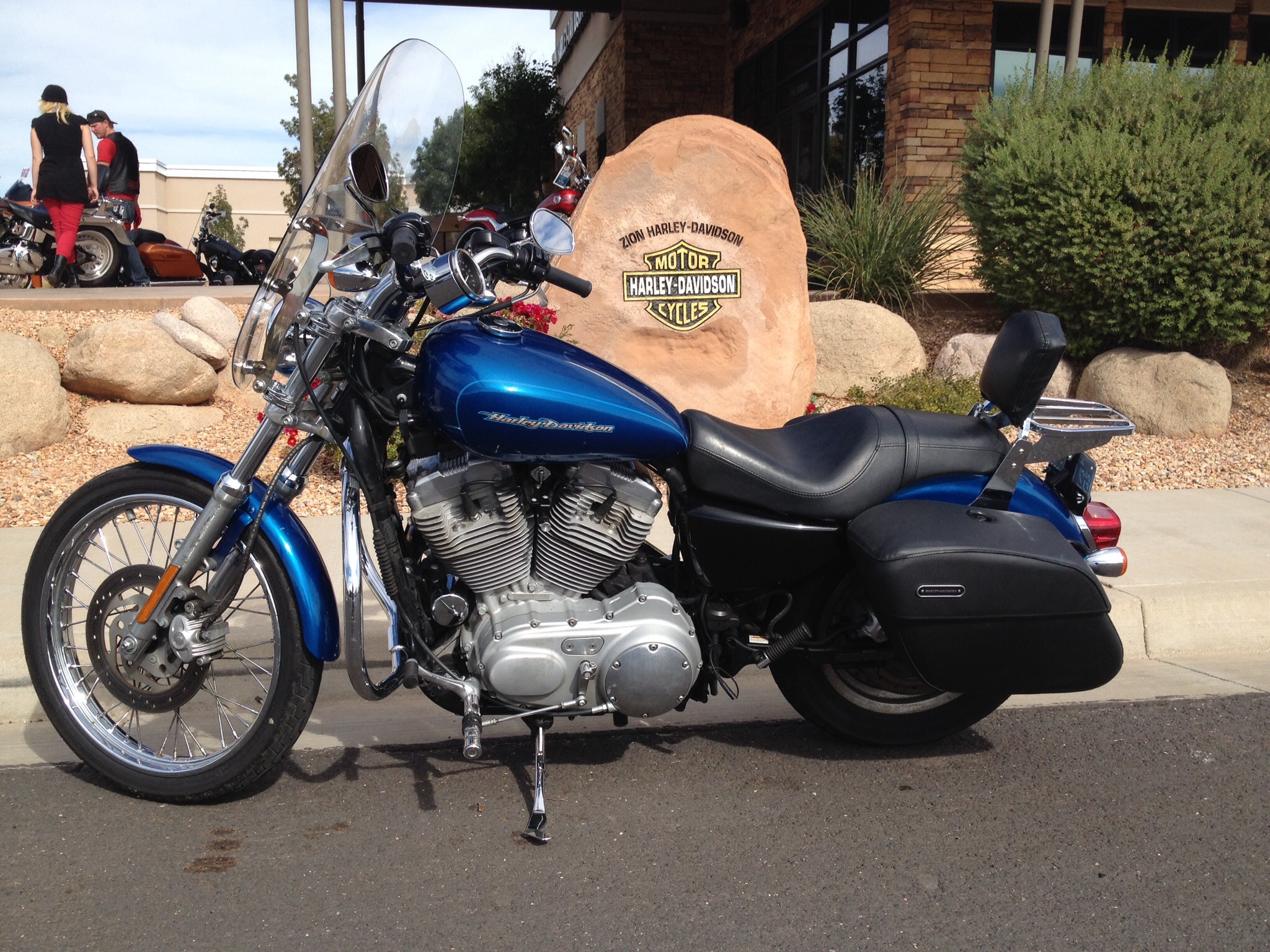
imageNo, we haven’t made it to Jeruselum (at least not yet). This Zion is actually located in St. George, Utah — where the excellent staff at the local Harley-Davidson franchise just replaced the drive-belt on my Sportster, allowing us to continue our way West. Cheers all around, Pacific Ocean bound!
image

Posted in Road Trip | Leave a comment

What Happened in the Tunnel

imageI know friends in Alaska who are all too familiar with a very similar sensation. You’re driving outside town on some dark winter night when suddenly you can’t see the road. You begin wondering if one or both of your headlights burned out.

Then you realize that, most likely, the lamps simply got dirty, probably from all the road-sand kicked up by passing cars. So you pull over, grab a handful of clean snow in your glove, rub the lamps clean, polish them with a paper towel, get back in your car and continue on your way. Problem solved.

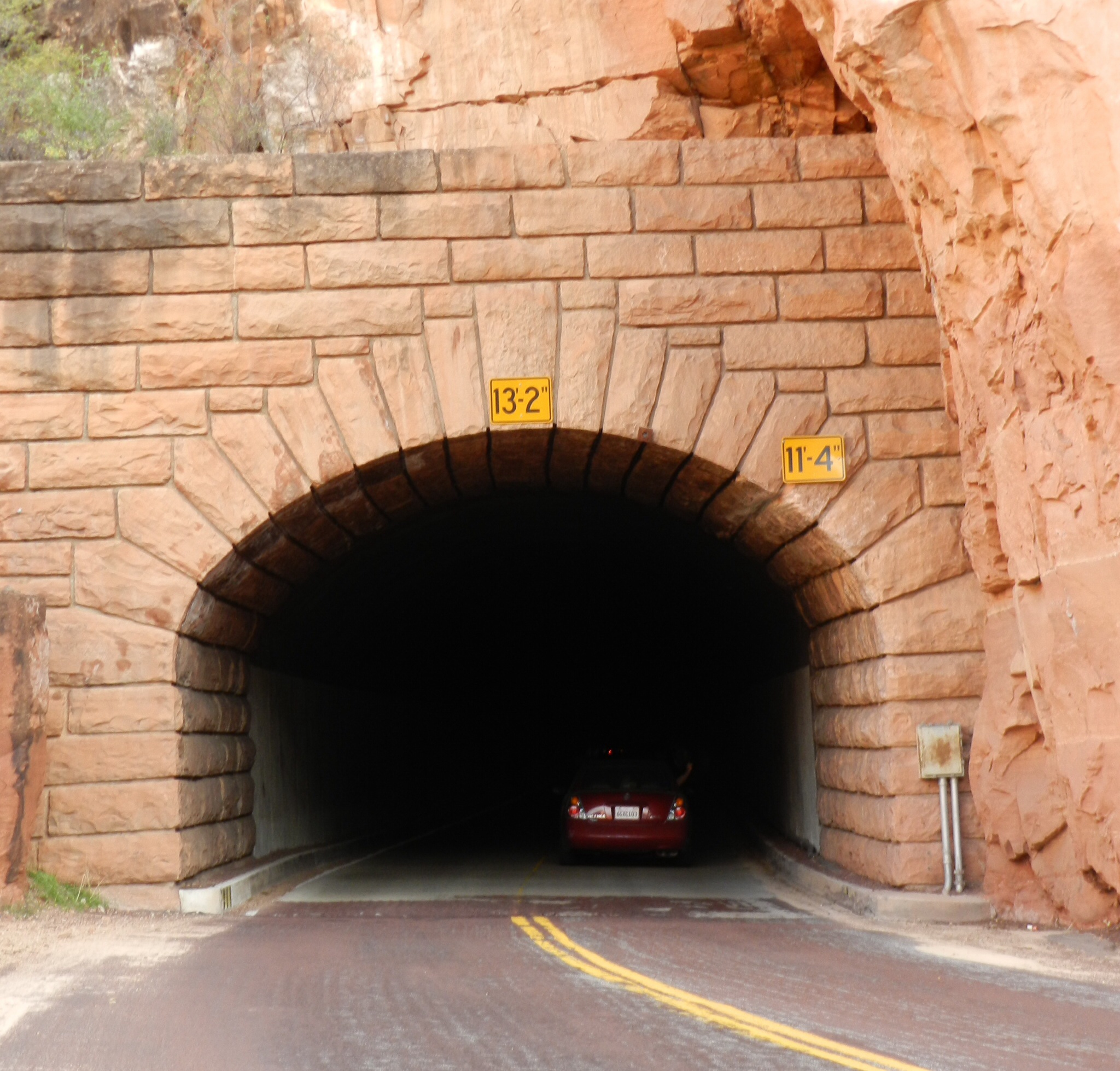
That thought occurred to me in the dark heart of Zion National Park in southern Utah yesterday less than a minute after entering the historic mile-long Mount Carmel Tunnel — one of the longest, narrowest and certainly darkest tunnels in America. The nearly century-old burrow passes through a sandstone mountain, inside of which there are no electric lights and no turn-outs and only one rule: DO NOT STOP.

For me and Harley, a better rule might have been: DO NOT ENTER.

For one thing, I had no idea how dark the tunnel was, nor how dirty (from a week of desert riding) Harley’s headlamp had become. For safety purposes, I hadn’t been riding at night at all, and this was the middle of the day.

Secondly, I didn’t know that in the very recent past — perhaps just five minutes earlier when I pulled onto the gravel shoulder of the park road to photograph the Bighorn ram on the cliffside — a small stone freakishly wedged itself between two teeth in my bike’s drive sprocket. And from then on, with every rotation, the little stone began sawing away at Harley’s thick, nylon-rubber drive belt.

So you can see where this is going.

But I didn’t. At least not then.

Entering the tunnel, I simply grew increasingly amazed at how dark and narrow it was. I checked my lights, but of course they’re automatically always on. So I switched on the bright light, but it was hardly better. I slowed down a bit. For some reason, there were no cars behind me to help illuminate the way, and the bleak way forward looked dark as a closet.

With two exceptions.

Every quarter mile or so, there was an opening on the righthand side of the tunnel where sunlight hitting the sheer cliff outside briefly shot through. For a moment I would get my bearings. Then it would be dark again. Also, two or three times, a car came straight at me from the opposite direction. For an adrenaline-inducing instant, its bright lights would both blind me and illuminate the narrow wormhole-like circumference of the tunnel — then thankfully pass on by. Then it was dark again.

So, yeah, I might have been looking forward to the end of the tunnel. Trying to make a little light of it, I might have thought to myself: Boy, what a lousy place this would be to break down …

When suddenly there was a great explosion from below … followed immediately by a loud FLAP-FLAP-flap-flap-flap! … followed by a total loss of power. Then kind of miraculously in the very same instant, the end was in sight. And Harley and I nearly coasted into the daylight, then I was able to quickly ground-pedal us all the way out of the tunnel and over to the side of the road.

In less than five minutes, a park ranger walked up to ask why I’d decided to park my motorcycle in such a precarious place. And I thought: not nearly as precarious as the inside of your tunnel.

But I was lucky he was there, because AT&T and my cellphone were both signaling “No Service” and I was fairly sure the nearest Harley Davidson shop was about 70 miles away. The ranger, however, had short-wave radio and was happy to call for a tow-truck. Which arrived about an hour and a half later.

So that’s why Harley and I are both residing for a couple of days in St. George, Utah, awaiting the special delivery of a brand-new drive belt. And grateful, too, for all our good fortune. Because, you know — it could have been worse.

I’ve also had a chance to piece together a short slideshow (see below) of some of the places and images from the week just past — as we traveled from Portland to Boise to southern Utah and ventured inside four national parks.

This slideshow requires JavaScript.

Posted in Road Trip | 2 Comments

Finish Line

It was a long day, it was a cold day. It would be the final day of our journey.

Or so I thought.

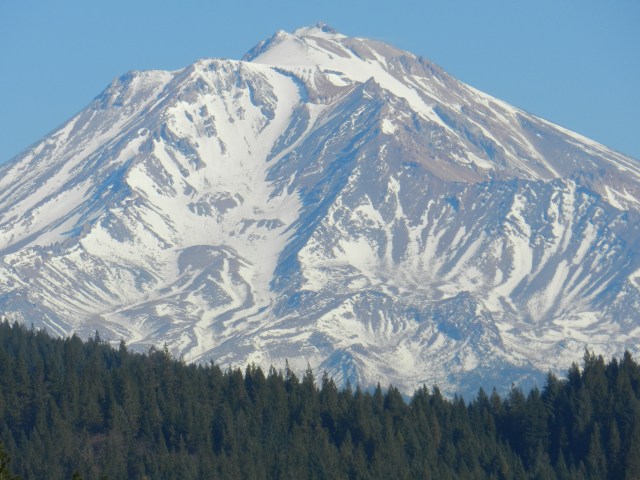
In Northern California yesterday — was it only yesterday? — we persevered through the Trinity Range north of Redding (see Mount Shasta above) in dry, freezing sunshine that reminded me of home. This was the kind of cold that’s manageable.

Then at the Oregon border we topped the Siskyous and ran into an ice cloud, which rolled over us like a wave, sank into my clothes and smothered all the scenery. This was the kind of cold that chills you to the bone and makes it almost impossible to see.

Fortunately on the Oregon side of the summit, still in the ice cloud, an exit sign appeared and we took it. And there around a corner was a rustic lodge with a restaurant that was open, and inside there was a fireplace and the smell of Christmas.

Seeing from my appearance that I’d been riding a motorcycle and could definitely use a warm-up, a desk clerk offered me a cup of coffee and pointed to the fireplace. “You ought to stand over there,” he said.

So I did.

About a half hour later, when I headed out again, the heat of that fireplace and the friendliness of the lodge warmed me all the way downhill to Ashland. There the fog thinned out but the chill remained. And from then on, for the rest of the day, I found myself stopping to get warm about every half hour. Around dusk, after we’d traveled about 300 miles, I stopped once again at a fast-food restaurant to get my bearings.

We were 50 miles south of Eugene. The trip’s long-deferred finish line in Portland was about 100 miles beyond that. It was getting dark and I was tired and cold. But if we kept plugging along, I told myself, we could make it to my niece’s house near Lewis & Clark College. It would be great to see my family again, and I could get a good night’s sleep before catching my schduled flight home the next day.

What a journey! We’d been on the road for three months, Harley and I. We’d traveled together 12,000 miles in a big wavy clockwise circle around the country through more than 30 states.

Through it all my little Sportster has never had a mechanical problem. He’s used virtually no oil at all. A few days ago in San Luis Obispo, I bought him a new front tire to replace one that had grown bare, and a mechanic tightened his drive belt. But those were my responsibilities. For his part, Harley’s never let me down.

And now we were nearly done. So I pulled on my gear for the thousandth time and headed back outside. It was dark now and darker still after we left the lights of Sutherlin behind us. I turned on Harley’s high beams to light up the divided highway and drove that way for about a mile.

A fast-moving car coming up behind us was preparing to pass, so I switched to the low-beams as a courtesy, watched it pass – then watched the highway before us turn black as night as the vehicle disappeared up ahead. I mean totally black. I was driving down the Interstate with no headlamp at all — the low-beam bulb must have blown! — and no sense of what was in front of me.

As quickly as I could I fumbled with my left thumb to toggle on the light switch for the high beam. Thankfully it went on – but almost as quickly an oncoming car flashed his brights at me to signal that I needed to turn off mine. I didn’t. What I did instead was annoy a few more drivers for another mile or two until I finally reached an exit. Where I turned around and returned to town.

And that’s where I woke up this morning.

I try my best not to ascribe to either animals or machines human emotions, but if Harley was trying to get my attention last night, he couldn’t have done a better job. If he wanted to nudge me and say, “Um, what are you doing? Why are we ending this trip in the darkness? Why not wait until tomorrow and enjoy the final miles? Why not finish in the light of day?”

And if that’s what he was trying to tell me, well then — good on Harley!
Because he was absolutely correct. The next day (today) broke in partial sunshine and the riding was comfortable all morning long. We continued north unhurried, passing through a landscape that alternated between forest and farm — an intense shade of green I always think of as Ken Kesey Country.

Then we pulled off in Eugene and rode past the stadium to pay our respects to the Rose Bowl-bound Ducks.  And when we finally did arrive in Portland, my brother’s garage was ready and waiting for Harley (he’ll spend the winter there) and my Alaska-born niece Karin was ready to whisk me away to the airport, just in time to catch my plane.

Which is where I’m sitting right now, rushing to complete this final post before they begin asking passengers to “turn off all your electronic devices.” The only problem is: There’s so much more I still want to say — about Harley and the risks of riding a motorcycle, about road trips in general and choosing to live deliberately, about what we found out there on our journey around America. So I’ll just have to post a few more.

Right now, however, I’m very much looking forward to a woodstove in Bear Valley, a homecoming with wife and family and the joy of  Christmas in Alaska.

So cheers to all — and thanks for riding along!

— George and Harley / December 12, 2011
Posted in Road Trip | 7 Comments

Pastures of Heaven

If you have to be an old bull put out to pasture, I’m thinking, you could do a lot worse than this sunny bluff overlooking the Pacific Ocean in the handsome Big Sur country of central California. Not to mention the 100 heifers a short walk away.

Pretty nice for road trips too — the old Highway 1 from Morro Bay to Monterey.

John Steinbeck, of course, knew this country well, especially the cannery district of old Monterey, which he affectionately described as “a poem, a stink, a grating noise.” But that Monterey was gone ages ago. In its place today you’ll find the Monterey Chamber of Commerce on steroids.

That’s why I was grateful to find the spectacular coastline south of Monterey still pretty much as wild as ever I remembered from road trips past. Steinbeck and his marine biologist buddy Ed Ricketts could have found tide pools galore down there, as I did. Plus a few elephant seals, goshawks and other critters as well.

This slideshow requires JavaScript.

Posted in Road Trip | Leave a comment

Where I came from

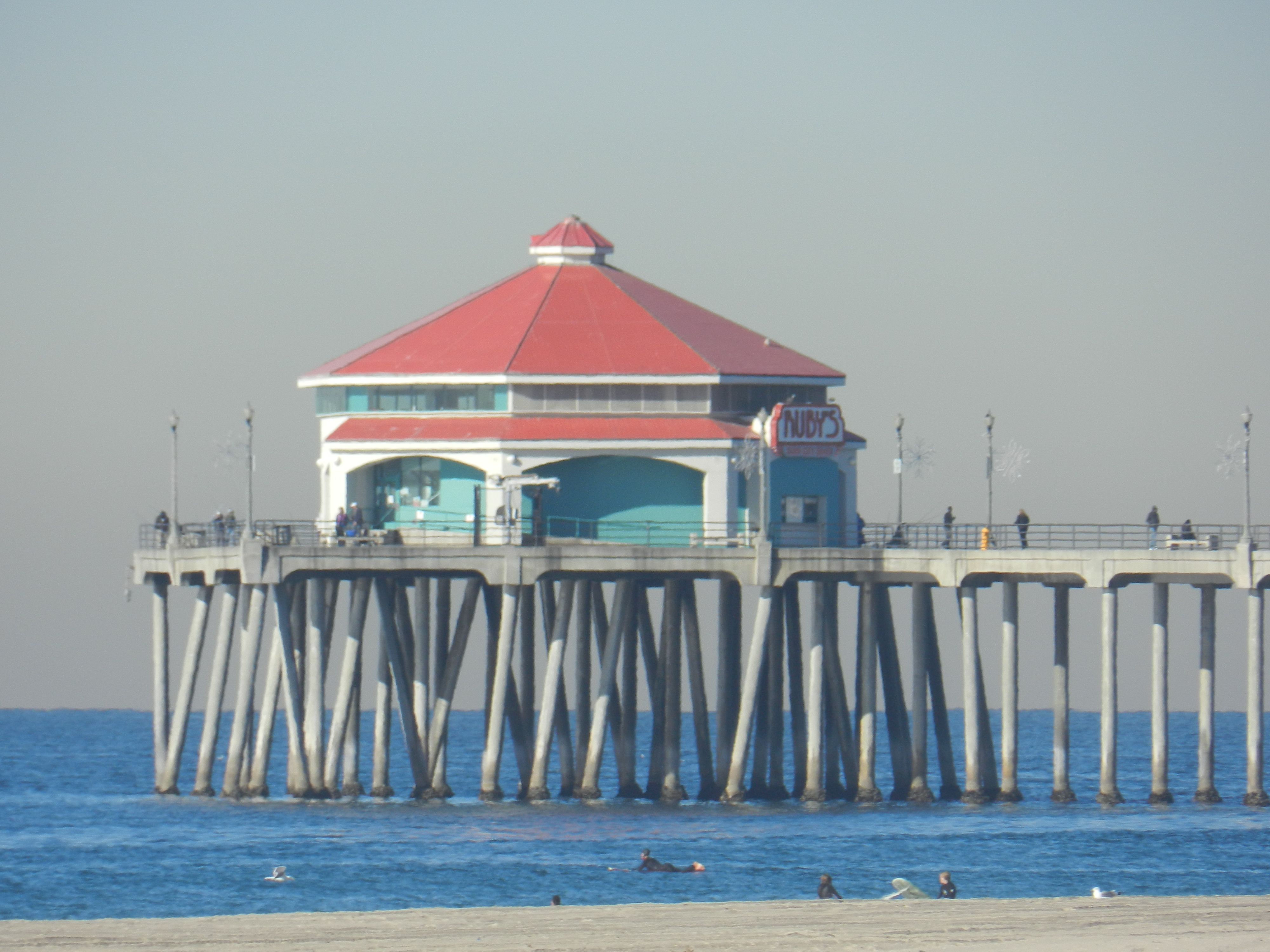
Traveling north, still a few miles short of my hometown, we passed by the old pier at Huntington Beach, where my teenage friends and I sometimes went surfing, sharing one board between us.

Since I wasn’t the board-owner, most of the time I simply body-surfed, but that could be challenging too. Because the swells at Huntington sometimes got big, and when they did, they broke well offshore in fairly deep water. And if you entered the wave too late — or if you failed to pull out when you should have — then things got crazy as the ocean crushed you under its weight, and a powerful gyre whirled you around, and you couldn’t tell which way was up.

That could be kind of funny for the first 20 seconds or so, until underwater your one gulp of air began to run out. Then it wasn’t funny anymore. Then you had to choose a direction that might be toward the surface and really swim for it. And sometimes in doing this you would abruptly ram your head into the sandy seafloor. And that was good in a way. Because at least then you knew you had to go the other direction.

Well, returning to your hometown after a long absence can be a little bit like that: Exciting in the beginning. Turbulent (or at least disorienting) in the middle. Clarifying in the end.

In the 1930s the southern writer Thomas Wolfe wrote a novel titled You Can’t Go Home Again.  What he meant by that, I think, is that both you and your hometown have changed in the meantime, so even if you returned it wouldn’t be the same.

On this journey, however, I approached the same predicament more literally. I really couldn’t go home again, because — for the first time in my life — my family no longer owns the Long Beach house I grew up in. We sold it last year after my mother passed away at the age of 94.

Neither of my parents went to college. They worked with their hands all their lives. In the heart of the Great Depression — shortly after they married in Long Beach in 1935 — my dad taught himself how to be an upholsterer and eventually owned his own shop. As soon as he could, he taught his sons to help him.

My older brothers and I grew up in my dad’s shop, tearing apart old furniture, salvaging the stuffing, repairing the frames, retying the springs, tacking on burlap and cambric linings — and more or less doing everything short of the actual measuring, cutting, sewing and upholstering of expensive fabrics that required my father’s skill.

Before the war ended and before I was born, my parents bought a large cottage — actually an old YWCA clubhouse with a huge fireplace and massive living room with old wrought-iron Spanish chandeliers hanging from the ceiling — then embarked on a long struggle to make the $25 mortgage payment each month.

But in that modest two-bedroom house (my brothers and I actually slept in the unattached remodeled garage we called the bunkhouse) they raised five children. And from that house we could walk to all the schools we attended. My elementary school stood nine blocks away. My junior high was six. My high school across the street.

There was a long block of athletic fields that separated our house from the actual high school, and my life was shaped by those fields. I could play football and baseball and tennis there year around. And in the high school was a pool where we all learned to swim. And one block beyond that was a public golf course, where you could sneak on around dusk for free.

Next to the golf course was a huge park with towering pines and fragrant eucalyptus trees and a Spanish mission styled amphitheater where starlight concerts and public picnics were held each summer. And beyond the golf course was a salt-water estuary dredged out of the shoreline to host the rowing events for the 1932 Olympic Games — where we all learned to water-ski. And beyond that was the ocean and Catalina Island and fishing in the open sea.

So, as you can see, even for working-class kids like us, we had it awfully good in the 1950s, ’60s and ’70s. And that’s because “Where I Came From” has an economic dimension as well. There was a burgeoning middle-class all across America back then, primarily because of the government policies advanced by Presidents Roosevelt, Truman, Eisenhower, Kennedy and Johnson.

The words “stimulus spending” hadn’t been coined just yet, but all the government borrowing and spending that occurred during World War II and immediately afterward would make anything that President Obama and the Democrats have proposed look timid and paltry by comparison. Taxes were much more progressive back then. That means the rich paid a far greater share than they do now.

So with all that tax revenue and government spending, people were put to work building the roads and public schools and parks I grew up with. And since jobs were much more plentiful — thanks again to government spending —  the economy grew and everyone did better. Even the rich. In fact it grew so much it was easy for the government to pay off its debts.

Like I was saying, a trip back home can sometimes clarify a few things.

Before this one was over, my sister and I got to place fresh flowers on our parents’ grave. I rode Harley to the old house and took some pictures. We circled my high school and the nearby park, and then I rode past my old elementary school — where they were still teaching kindergarten in the same room where I attended kindergarten, and the current teacher gave me a tour. I rode Downtown to see the Christmas decorations, took one last glimpse at the ocean — then my motorcycle and I continued on our way.

This slideshow requires JavaScript.

Posted in Road Trip | 10 Comments

The King’s Highway

So I stopped for lunch in San Juan Capistrano, home of the Spanish mission, which I didn’t realize until now is the oldest building in California — and the etymological source of my blog.

Let’s see if I can get this straight:

Travels with Harley was inspired in part by my reading of Travels with Charley, the book the author John Steinbeck wrote 50 years ago about traveling the country in a truck with his dog “in search of America” — or at least the country as he found it in the fall of 1960, which had changed profoundly from the America he once knew.

But Steinbeck wasn’t all that original himself.

He borrowed the name of his truck, Rocinante, from the name the Spanish author Miguel de Cervantes gave the horse of his fictional Don Quixote. And he took his own book title from Travels with a Donkey, written the previous century by the Scottish author Robert Louis Stevenson, about his travels around the French countryside with a burro.

Nor was Robert Louis Stevenson that original.

He was inspired by a Franciscan friar named Father Junipero Serra, who the previous century founded the Spanish missions of Alta California along El Camino Real — “The Royal Road,” aka “The King’s Highway” — a dirt path that extended roughly 600 miles up the spectacular California coastline, from San Diego to San Francisco, wherein he spaced each of those 21 missions roughly 30 miles apart, or one day’s travel by horse and donkey.

(Stevenson, himself, visited those missions, and he also based his popular Treasure Island on the real-life shipwreck that Father Serra experienced in the Caribbean Sea.)

So we come, full circle, to San Juan Capistrano, about 50 miles north of San Diego, returning like the swallows, just as I am about to come back full-circle to the place where I was born.

This slideshow requires JavaScript.

Posted in Road Trip | 9 Comments

Gabby’s District

Before I continued my way west across Arizona on Sunday, I got wondering what I’d find if I knocked on the door of Congresswoman Gabrielle “Gabby” Giffords’ district office in east Tucson. I expected no one there.

Certainly not the Congresswoman.

Ever since a lone gunman standing three feet away shot her in the brain last January, the third-generation Arizonan has resided elsewhere — mostly in Houston, where emergency-room doctors saved her life and a brain-injury rehabilitation team has since guided her remarkable recovery.

Recently Giffords returned to Tucson for the first time since the shooting to serve Thanksgiving dinner to airmen at the local Air Force Base. She was joined there by her husband, retired astronaut Mark Kelly. About the same time, the couple appeared on the “20/20” ABC-TV show, where they were interviewed by Diane Sawyer.

At the end of this post, after the slide show, I’ve placed a link to a recent New York Times story (photo on left) detailing Giffords’ recovery — including an excerpt from the TV interview and a recent audio message from Gabby to her constituents. Both are brief and really powerful.

Reading the story and listening to the video clip made me want to visit her office all the more. Maybe I could catch a staff member or two working on a weekend. But when I arrived there Sunday, the parking lot was empty and the glass door to the office was locked.

I peered in through the glass and didn’t see anyone. But I could see a lot of the office furnishings — including an old western saddle on a wooden sawhorse, a nice assortment of western paintings and sculptures, a large poster of Gabby and a map of her district.

The 8th congressional district of Arizona includes the eastern half of Tucson and about 9,000 square miles to the south and east. It’s an extraordinary expanse, encompassing the high-tech sector of one of the nation’s fastest growing cities, huge farms and ranches, two military installations, more than a hundred miles of the U.S.-Mexican border and one national park.

In fact Saguaro National Park is only 15 miles from Gabby’s office door. Since my timing didn’t allow me to see the congresswoman herself, I decided I could at least glimpse the crown jewel of her district. And now I’m really glad I did.

For one thing,  the whole park is easily visible from one eight-mile-long road loop, and within it is one of the most spectacular desert forests in the world — with its abundant barrel and prickly-pear-pad cacti and exotic chain-fruit and teddy-bear chollas.

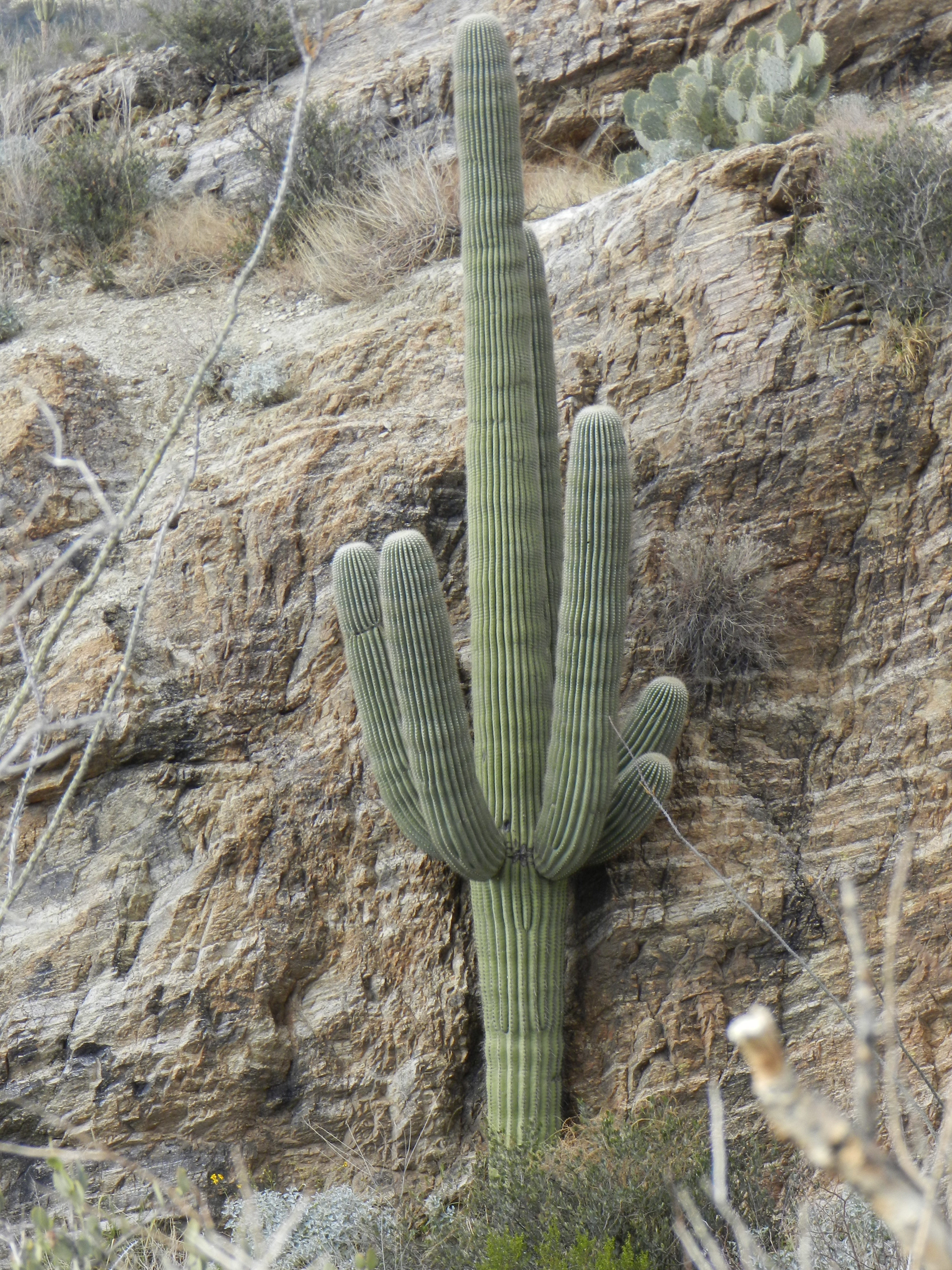
Lording over it all, however, is the giant saguaro cactus, which can grow over 70 feet high and live a couple hundred years. I now know many things I could tell you about the saguaro, including its correct pronunciation (it’s suh-WAH-ro — the “g” is silent). But I’ll limit myself to just one thought:

The odds against its survival are huge.

Living in one of the most hostile natural environments on earth — the Great Sonoran Desert of southern Arizona and northern Mexico, where several months can pass in the spring or fall without a single drop of rain — it perseveres by sending out a very shallow root system (about three inches deep) in a circle as broad as the cactus is tall. When the rain finally does fall, these hairy tendrils suck it up as if their collective life depended on it.

Then the ingenious above-ground portion of the saguaro kicks into action, with its accordion-like pleats expanding when water is plentiful, its waxy outer skin locking the moisture inside, its prickly spines shading the plant from the evaporative effect of sun and wind and protecting it from thirsty animals. Sometimes one rainfall is all the saguaro gets for a year.

But all that assumes that a baby saguaro succeeded in ever reaching its teenage years in the first place, and only about one in a thousand seedlings do. The saquaro grows at an excruciatingly slow rate at first. At eight years old, it only measures about an inch and a half high. After another eight years,  it barely reaches a foot. The fauna of the desert is constantly tramping it down.

All in all, I decided, the saguaro — “monarch of the Sonoran Desert” — stands as the perfect symbol of the life-force, of things that struggle against great odds to survive. Not unlike Gabby Giffords herself.

This slideshow requires JavaScript.

Here’s the New York Times story link:

Posted in Road Trip | 12 Comments

Waltz across Texas

How many negative associations toward Texas had I accumulated in a lifetime? Let me count the ways.

There was the time the Dallas Cowboys first began calling themselves “America’s team.” That would make the list.

There were the Texan oilfield workers who flooded Alaska in the 1970s to grab the best pipeline jobs, make a bundle and leave the state as soon as they could. That one too.

There was the 43rd president of the United States and his eight years in office … but straying into politics really isn’t fair.

Suffice it to say that if part of the purpose of my journey around the country this fall was to expand my consciousness and shed old biases, I had my work cut out for me in Texas. Just traversing the state from one side to the other deserves a medal.

When Harley and I crossed the Gulf Coast border from Louisiana into Texas on Highway 10 a week ago, a mileage marker there informed us: “Beaumont — 25 miles … El Paso — 857.”

In the six days it took us to cross that distance, I would be challenged even more by my own mental lapses, leaving Harley’s accessory lights on at a restaurant, draining his battery, running out of gas, getting caught in the worst windstorm of the trip.

I would learn that in Texas roosters and wild turkeys are not intimidated by motorcycles, but rather find them strangely appealing (see pictures below), at least when the bikes are motionless or undergoing repair.

I would leave my coffee thermos behind at a McDonalds restaurant — and have my glasses blow away in the dark near El Paso. In that same storm, with 50 mph crosswinds, I would watch a sprinting coyote fly across the highway just a few yards in front of us, a tailwind sending him airborne.

I would pitch my tent in the scrub oaks of the Davis Mountains, where the elderly woman who served as campsite host warned me about the local mountain lion and the mischeivous javelinas.

I would pass through four of the major cities of Texas — Houston, Austin, San Antonio and El Paso — and walk through the courtyard of the Alamo. But Harley and I would also ride 100 miles out of our way to see the dying town of Marfa, Texas, in the Chihuahuan Desert, where the classic movie Giant was filmed.

I would get drenched by a couple of rainstorms, but also enjoy some spectacular blue-sky days of t-shirt riding on the wide-open backroads of West Texas and have my memory seared by a few unforgettable sunsets.

Most of all, however, I would get to talk to a lot of Texans, most of whom just seemed like real nice folks — and some who went far out of their way to help.

(Which reminds me: Some of my personal heroes — like the late Molly Ivins, Bill Moyers and Willie Nelson — were Texans too.)

So consider me now more than a little bit co-opted. Like Willie says in the old Ernest Tubbs tune (in the link below the slideshow): … I’m lost in your charms/ I could waltz across Texas with you. 

This slideshow requires JavaScript.

Posted in Road Trip | 5 Comments

Moveable Feast

Leaving the south now and moving west. Way out West.

But before saying goodbye to the gentility of Vivian Leigh (in A Streetcar Named Desire)  and hello to the generosity of Elizabeth Taylor (in Giant), I would be remiss if I failed to publicly acknowledge just how much I enjoyed both southern cooking and southern manners.

So here’s a raised glass to a couple of excellent (in spite of being so darn inexpensive) dining establishments in the South where I really enjoyed both the food and service — and the friendliness of the folks I shared it with:

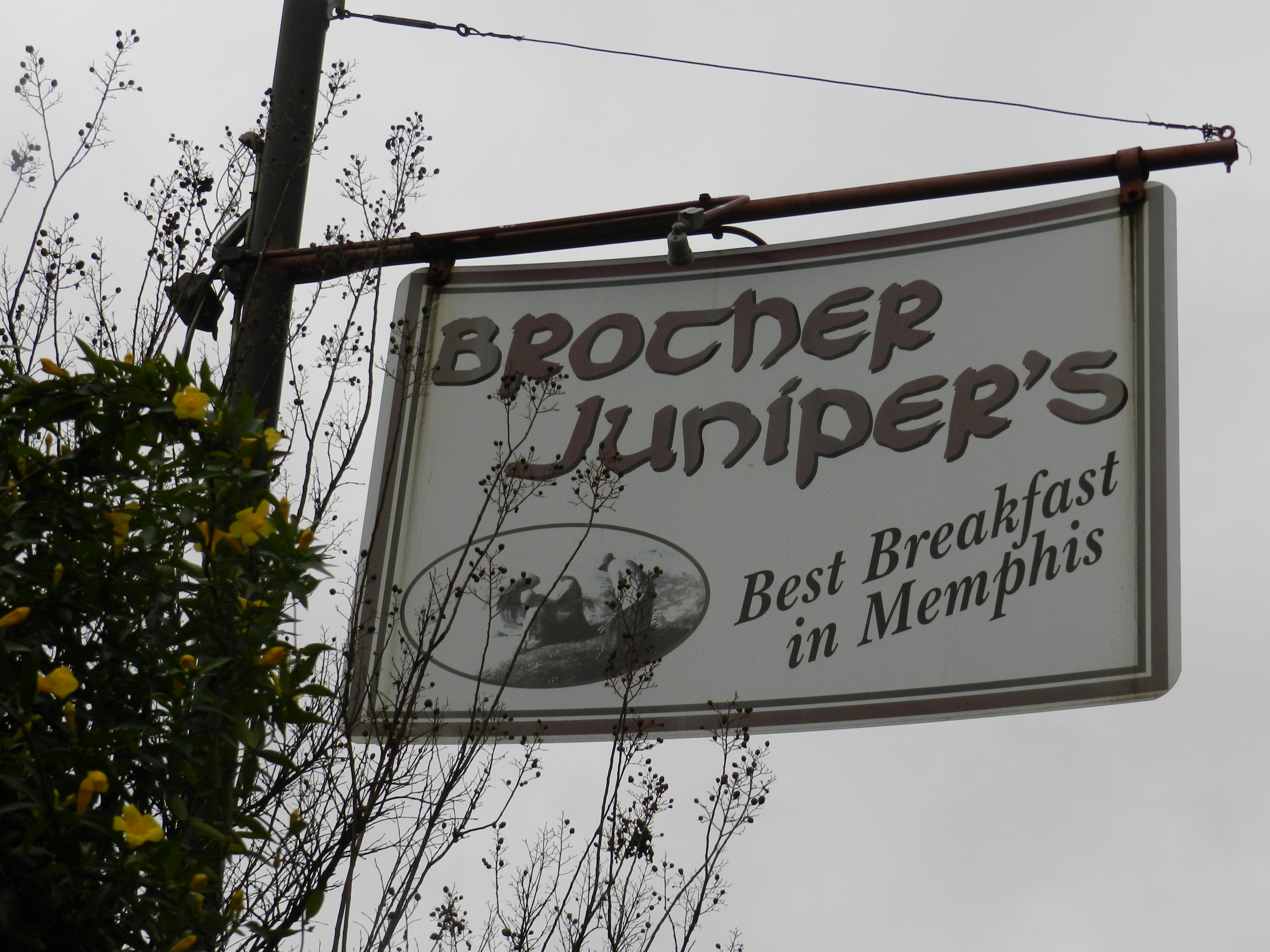
• Brother Juniper’s (for breakfast) in Memphis, Tennessee, where some food reviewer named Rachel Ray really loved the open-faced omelets — but I was just as appreciative of the homemade bisquets & preserves, cheese grits, country sausage and delicious deep-roast coffee.

and …

• Boudreau and Thibodeau’s Cajun Cookin’, in Houma, Louisiana (for lunch or dinner), where I tried — and loved — the catfish, jambalaya, red beans with rice — and a glass of the local ale. All while joining the locals watch their beloved LSU Tigers beat the daylights out of the Arkansas Razorbacks.

Adieu, Gulf Coast. Adieu.

Posted in Road Trip | 1 Comment