What the Road King said

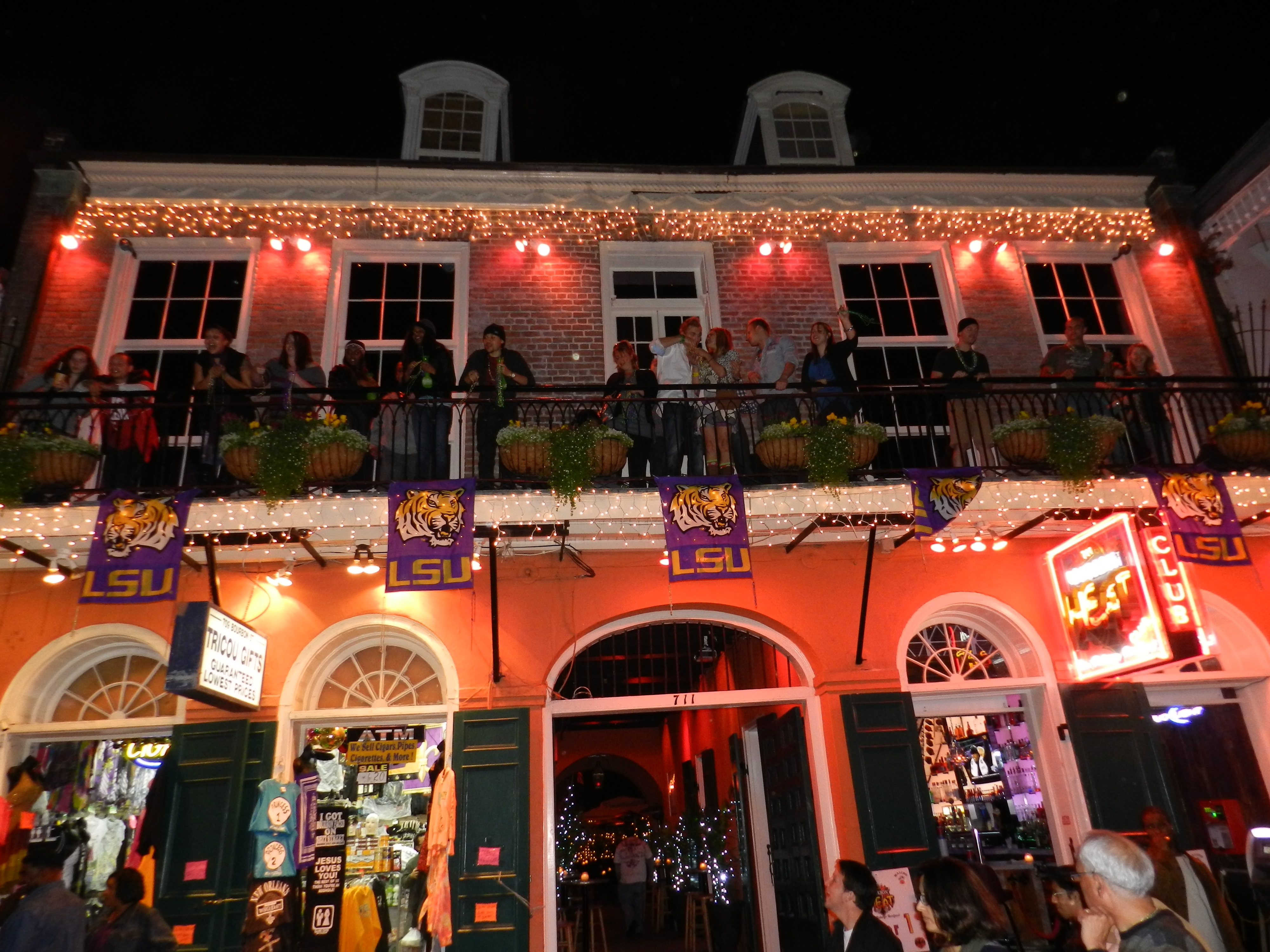
Scotty on Bourbon Street in New Orleans. Thanksgiving Day, 2011

It was Thanksgiving.

I’d been hoping to reach New Orleans by mid-afternoon, ideally in time for an open-to-the-public turkey dinner at a neighborhood church — but we arrived too late in the day.

Turning off the highway near the Superdome, I pulled over in the dusk to consider Plan B — and realized I didn’t have a Plan B.

Not only was I sorely missing my family just then, I’d now missed my substitute soup-kitchen dinner as well. The least I could do, I decided, was mingle in a crowd. But where? Maybe I could just follow the flow of traffic. Maybe it would lead to someplace busy or interesting.

And guess what? It did.

About a mile down the street, in the heart of Downtown New Orleans, the traffic slowed to a standstill near a roadblock. People on the sidewalks were all walking in same direction, as if there was something there to do or see.  So I parked Harley in a space too small for a car (thank you, little motorcycle!) and grabbed my camera to join them.

Which is how I got to watch the last 15 minutes of the annual New Orleans Thanksgiving Day Parade – and caught a beaded necklace when someone on a parade float passed by and threw it into the crowd in my direction.

Striking up a conversation with another spectator, I learned that the restaurant and nightclub district in the fun-loving French Quarter was located just a few blocks away across the street. So that’s where Harley and I went next.

Parking next to a few other motorcycles just off Bourbon Street, I grabbed my camera and walked off down the street to take a few pictures. When I got back, a big, tattooed guy with a head scarf noticed me and said: “There’s someone looking for you.”

This sounded ominous, until he added: “He saw your Alaska license plate. He just wants to talk to you…. There he is. Hey, Scotty!…”

Then a smaller middle-aged man with grey hair and a black jacket walked over without any expression and gestured toward Harley.

“Is that you?” he asked.

“Yes,” I said.

He was standing next to an old Harley-Davidson Road King, loaded down with camping gear.

“And is that you?” I asked.

“It is,” he said.

Such are the polite formalities between strangers on the road.

Over the next 15 minutes we chatted about our travels and our gear.

“This is how I live,” Scotty said, gesturing at his bike. “I’ve been on the road for 18 years. I never stay in one place more than three months.”

It impressed him, I think, that I live in Alaska. He’d biked there once, partly on the ferry. He always heads north in the summer – to Oregon or Canada usually. In winters he turns around and searches out someplace south — like New Mexico or even “Deep Mexico” in Acapulco — where he can still sleep warmly under the stars.

I mentioned I’d been camping out, too, mostly in the West — but I’d found it much harder to do in the East, at least in the fall, when most campgrounds have closed for the season.

“You stay in campgrounds?” he said, sounding disappointed. “You don’t have to do that. There’s always somewhere you can sleep outside for free. Even here in New Orleans.”

Sometimes he sleeps next to a local cemetery, Scotty said. Right now he was camping under the Huey P. Long Bridge with no hassles at all.

“Well, you know,” I said, feeling a little defensive, “part of what you’re paying for in a campground is a chance to take a warm shower.”

“You know how to get a free shower, don’t you?”

No, I said. How?

“Do you really want to know?”

Yes, I said. I did.

And it donned on me about then that his story might be interesting, so I asked if he’d mind if I recorded him.

Nah, he didn’t mind, Scotty said.

“OK, you know those highway truck stops that have showers? When a trucker buys 50 gallons of fuel or more they give him a free shower ticket.  So all you have to do is ride your bike out to the fuel island, where they’re  fueling up — so the truckers can see your bike, so they know you’re not some kind of bum – and ask if any of  them has an extra shower ticket.”

Sometimes it’s even easier. Sometimes he’ll nonchalantly park his bike between the fuel islands and sit down with a cup of coffee, kind of indifferent to the truckers, Scotty said. And they’ll approach him just out of curiosity.

“It’s kind of important that they see the bike,” he said. “You know, sometimes these truck stops get these real losers hanging around. They get homeless out there, you know.”

Suddenly I had a dozen other questions I wanted to ask Scotty. How did he support himself on the road money-wise? What kind of work did he do? Did he have any family? And where exactly was this free campsite underneath the bridge?

I’ll never know the answers.

Because just about then, some kind of Bourbon Street flash mob thing got going, and it got too hard to hear. Then the dancers showed up — and the police on horseback — and Scotty’s attention got diverted.

So ended my conversation with the Road King.
This slideshow requires JavaScript.

Posted in Road Trip | 2 Comments

New South — Oxford, Mississippi

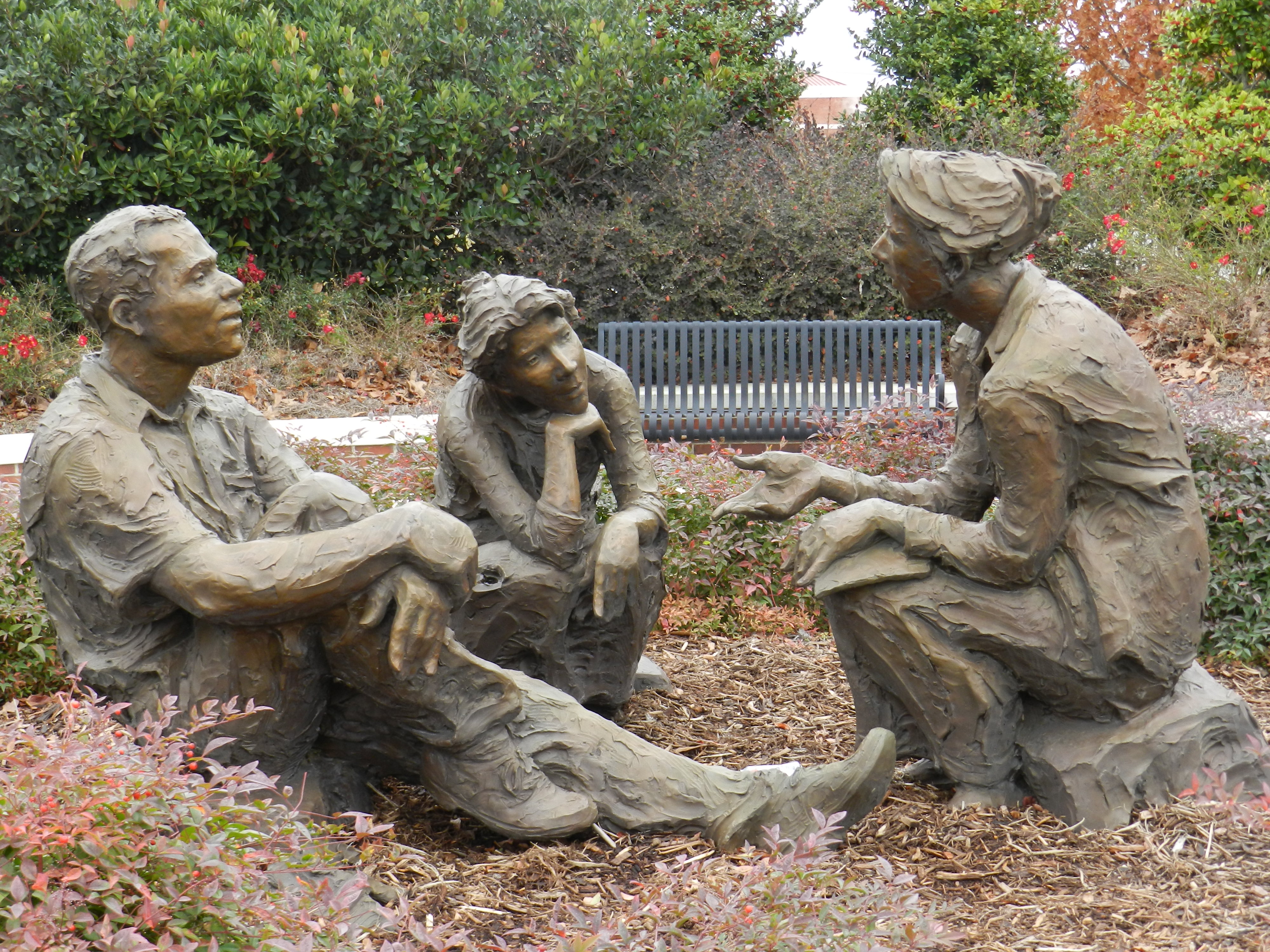
"Mentor" by Jane DeDecker -- public sculpture, University of Mississippi

First, the back-story.

While touring the country with his dog and truck a half century ago, John Steinbeck’s journey around America finally hit a kind of emotional wall in the Deep South, where he witnessed firsthand the forced integration of two public schools in New Orleans. It wasn’t pretty.

What they were trying to do that fall of 1960 — six years after the U.S. Supreme Court (in its pivotal Brown v. Board of Education decision) outlawed segregated public schooling in America — was simply allow four small African-American girls to enter the first grade in two all-white public schools. That was it.

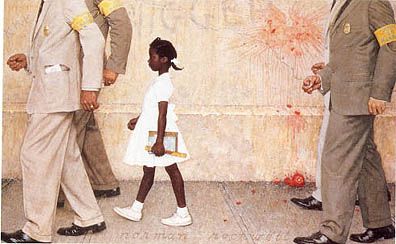
Maybe you’ve seen American artist Norman Rockwell’s iconic illustration showing one of them, 6-year-old Ruby Bridges in her shining white dress, walking to school amid a phalanx of federal marshals, a tomato someone had thrown dripping off the wall.

And the tomatoes weren’t the only things thrown. White protesters lined the front of Ruby’s school for weeks shouting insults. They did the same for the other girls attending a different school.

A group of white mothers who’d become known in the media as “the cheerleaders” were especially vile in their taunts. One of them joked about poisoning Ruby’s food (and school officials took the threat seriously enough that they wouldn’t allow the first-grader to eat anything at school that she didn’t bring from home). Another woman brought to the protests a little wooden coffin that had a black doll inside (and later Ruby would write that the dead doll scared her more than anything else).

But the nastiest taunts of all, Steinbeck said, seemed to be reserved for the one or two white parents who continued to bring their first-grade kids to school when all the other white parents wouldn’t. And when one such father walked his son to the schoolhouse door, the cheerleaders went wild.

“No newspaper had printed the words these women shouted,” Steinbeck wrote in Travels with Charley. “It was indicated that they were indelicate, some even said obscene…. But now I heard the words, bestial and filthy and degenerate….”

The whole experience so disturbed the Nobel-Prize-winning author that once he returned to the road he suddenly found himself rushing toward his journey’s finish line more than a thousand miles away in New York City. And there his Travels with Charley (published two years later) abruptly concluded.

But civil unrest over efforts to desegregate schools in the Deep South lingered on, most famously in Oxford, Mississippi — where two years later James Meredith tried to become the first African-American to enroll in the all-white University of Mississippi. He knew it wouldn’t be easy. But if little Ruby brought out the worst in the local women of New Orleans, Meredith, a military veteran who’d previously studied at Jackson State, seemed to have the same effect on the local men of Oxford.

For two days they rioted on campus in demonstrations that frequently turned violent.   According to a follow-up report in Time magazine, 160 federal marshals were injured in the riots, 40 U.S. soldiers were wounded and two people were killed. One of them was French journalist Paul Guihard, who was shot in the back near the steps of the oldest building on campus.

So, that was then.

Fifty years later, here’s what I found as I rode my motorcycle down the very center of the campus at Ole Miss: The most peaceful and pastoral scene you could possibly imagine, partly because the campus was almost empty. It was the day before Thanksgiving. Most of the students had fled the university the day before to celebrate the holiday at home. But remnant signs of the world they now inhabit there were all around. Quite literally.

On the huge electronic-light billboard on the side of the football stadium on campus was the image of a black basketball star in a promo for an upcoming game. In a window of a sports shop nearby was a photo of this year’s Ole Miss football team, in which the overwhelming majority of the players today are black.

I ventured inside the store. It was nearly empty, but two female student employees — one white and one black — were chatting amiably about world literature. The black girl was recalling how, in the high school she attended, she had to memorize and recite before her whole class the “Prologue” to Canterbury Tales — in the original Middle English.

“Whan that Aprill with his shoures soote/ The droghte of March hath perced to the roote…”

I’d previously read how Ole Miss today has a fair share of English majors and promising writers, and these two students seemed to fit the bill. Part of the attraction of Ole Miss, of course, is the fact that Oxford was the hometown of the great American writer William Faulkner, who turned it into the fictional “Jefferson” of “Yoknapatawpha County” in several of his novels.

The university also has one of the top law schools in the country. And its said only half-jokingly that everyone in town today is either a writer, or a lawyer — or both.

Outside again,  I walked through “The Grove” of oaks that serves as the heart of campus. A path down the middle leads to “The Lyceum,” with its classic Greek columns, the oldest building on campus.  It’s said that its columns are still marred by the bullet holes of the shots that were fired back in 1962 when James Meredith tried to walk through its doors.

Now there’s a bronze statue of Meredith near the front of the building commemorating the college’s first African-American student. And nearby is a plaque — put there by the class of 2005 — that enshrines “The Ole Miss Creed.” It says the university today is dedicated to nurturing excellence in intellectual inquiry “in an open and diverse environment.”

Moreover:

As a voluntary member of this community: I believe in respect for the dignity of each person. I believe in fairness and civility. I believe in personal and professional integrity. I believe in academic honesty. I believe in academic freedom. I believe in good stewardship of our resources. I pledge to uphold these values and encourage others to follow my example.

A creed even Faulkner would have welcomed.

This slideshow requires JavaScript.


Posted in Road Trip | 10 Comments

Leaving New Orleans

“Blue-sky morning! Rain-free riding! George, what are you waiting for? Get going, man —now! Ride like the wind! Ride like the wind for Texas!”

But Bike Guy, I’m not ready. I still need to write that post about breakfast in Memphis. And the one about Oxford, Mississippi — and my ride through Faulkner Country and those changes I saw at Ole Miss. And then that thing that happened last night on Bourbon Street. Plus, you know, I was kind of having fun here…

“Little Sportster-rider, do I need to remind you about Tennessee? Does ‘three days and three nights of pouring rain’ spark any memories at all? Have you completely forgotten that you’re now running two weeks behind schedule — and next month you have that plane to catch in Portland?…”

OK, OK — I’m going. I’ll write those posts later. But I’m not going to ride like the wind. I’m going to ride safely and humbly, just like Someone I know once told me to.

Posted in Road Trip | Leave a comment

Best of Tennessee

When asked by a reporter why he spent so much of his life trying to rob banks, the convict William “Willie” Sutton famously replied: “Because that’s where the money is.”

Exactly.

And if you were to ask why I spent so much time this past week traveling across Tennessee,  which last I checked is only one state, I could reply: “Because that’s where the long open road is.”

Look at the map.

Tennessee is like a big wide dinner plate of a state (bordering eight other states) — from the Appalachians in the East to the Mississippi in the West — and there is much to see in between.

For me that included visits with two of my three wonderful but wayward daughters — Rosie, a college junior in Knoxville, and Molly, an inner-city school teacher in Memphis.

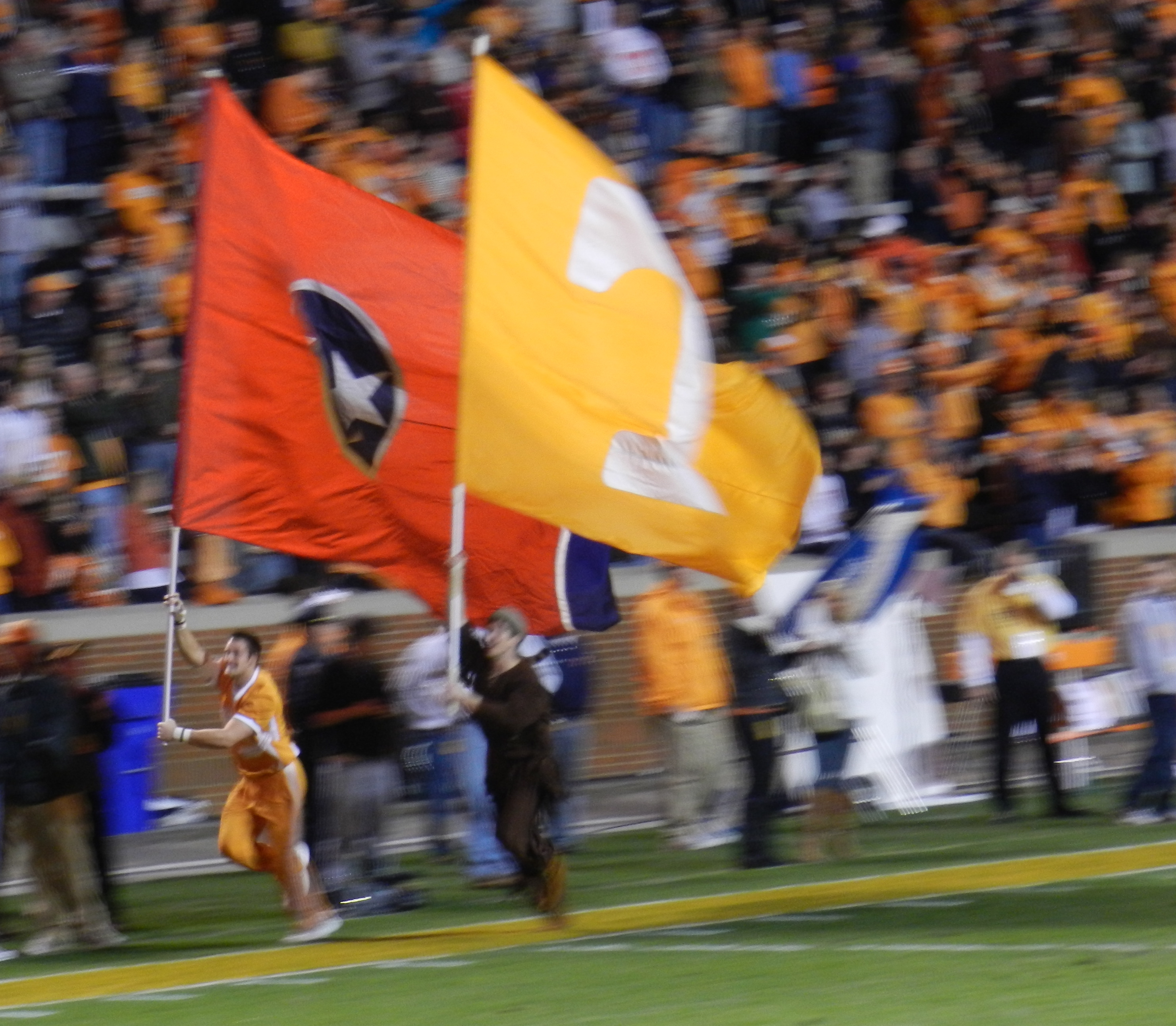
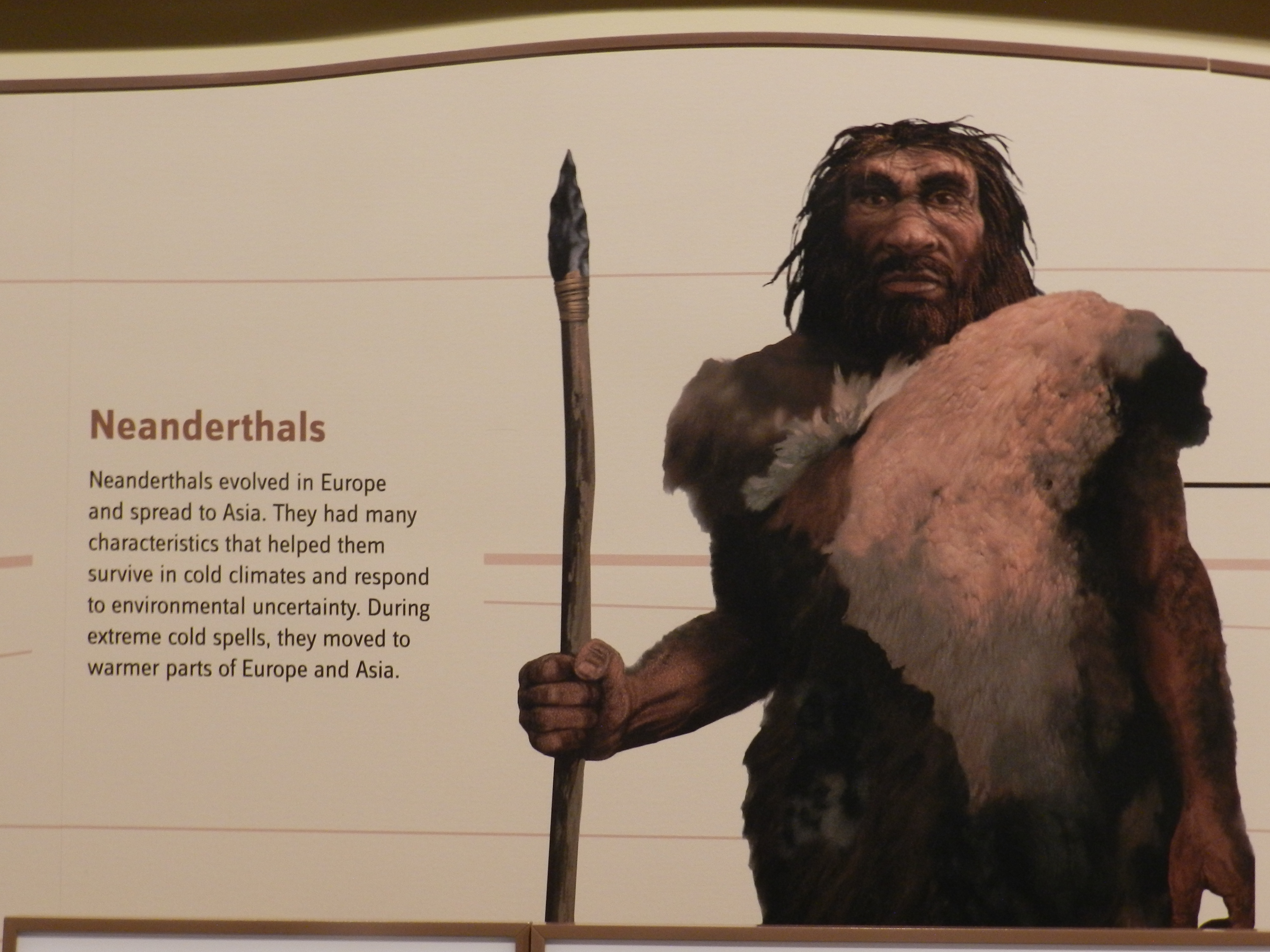
Because she knows her dad loves both the life sciences and football, Rosie led me first on a tour of the University of Tennessee’s human origins museum, then topped it off with tickets to the Tennessee-Vanderbilt game a few blocks from where she lives — where the orange-clad UT fans view football as something akin to a religious crusade and never ever tire of singing “Rocky Top.” The game didn’t disappoint either. Tennessee won a thriller in overtime.

On the other side of the state, Molly joined me (yet again) on a pilgrimage to Beale Street, home of the Blues, with dinner in the old Majestic theater. And there’s where I lose all objectivity. I really like Memphis. Its food, its people, its spirit (in spite of its tragic history). I’d previously toured the Martin Luther King museum there, where the great civil rights leader was assassinated.  I’ve even dipped my toe in Mark Twain’s river.

And now I get to follow that river down to New Orleans — for a little Thanksgiving turkey.

This slideshow requires JavaScript.

Posted in Road Trip | 4 Comments

You talkin’ to me?…

This slideshow requires JavaScript.

Sorry but something about the name of this place (in the Great Smoky Mountains of North Carolina) struck me as a little bit funny.

Posted in Road Trip | 1 Comment

Father of his country — and slave-master

Passing by Mount Vernon just south of Washington D.C. last week, I decided on a whim  to visit George Washington’s ancestral home, which I’d never seen before.

Paying to take the tour (the home is privately maintained and not visible except by tour), I learned several interesting details about our first president’s extraordinary life and indispensable role in helping America win the Revolutionary War.

But I also couldn’t help but notice what was missing from the tour, namely much in the way of specifics about Washington’s greatest character flaw — the fact that he owned hundreds of slaves and didn’t free a single one in his lifetime.

Some historians would say that founding fathers like Washington and Jefferson who owned slaves were merely reflecting the Virginia society they lived in at the time.  And that was certainly true.  Except that both Washington and Jefferson found slavery morally troubling and yet failed to emancipate their own slaves when they finally had the chance. (Prior to 1982 it was illegal to emancipate slaves in Virginia.)

Jefferson was especially appalled by the slave trade — if not slavery itself — and as America’s third president led the legislative battle that ultimately (in 1806) outlawed the importation and selling of new slaves. Washington, himself, stopped selling slaves after the Revolutionary War, not wanting to break up their families.

He also considered freeing all his slaves while the war was still in progress, but ultimately concluded it wasn’t economically feasible for his family to do so.

How could that be?

Washington biographers who’ve delved into the subject say, first of all, you have to understand that America’s first president didn’t just own a few house slaves. He owned a plantation’s worth of field slaves who performed all the manual labor on one of the largest farms in Virginia.

His father had built the original home there on 2,000 acres, but Washington remodeled the house into a 22-room mansion with numerous out-buildings and extended the family’s land holdings to 8,000 acres. On his land he grew more than a hundred different crops. While most of his neighbors were fixated on farming tobacco, Washington was an early adapter at raising wheat. And with the wheat and other grains as essential ingredients he built a huge distillary, one of the largest in the land. And all of it was predicated on slave labor.

Much has been written about Jefferson as a slave-owner, particularly his liaison (as a widower) with Sally Hemings, who gave birth to four of his children. But relatively little has been written about Washington on the same subject, though at the time of his death Mount Vernon housed 316 slaves, more than twice as many as Jefferson maintained at Monticello.

How did Washington come by so many slaves?

By getting an early start, according to research conducted by Henry Wiencek, author of An Imperfect God: George Washington, His Slaves, and the Creation of America.

Washington’s father had died when his son was just 11, but his will awarded young George the sum of “10 slaves.” Then Washington married into some more. Martha brought with her a “dowry” of more than a hundred slaves who were originally the property of her first husband. At the time of Washington’s death in 1799,  his plantation housed 153 slaves owned by Martha’s estate, 123 owned by the president and 40 leased from a neighbor.

To his credit, Washington ultimately broke the cycle of passing on slaves to his children. His will stipulated that the 123 slaves he owned outright be emancipated upon the death of his wife (who passed away two years after he did), and that his heirs care for his ex-slaves (who lived that long), “the elderly ones to be clothed and fed, the younger ones to be educated and trained at an occupation.”

And to the credit of the private non-profit organization that now maintains Washington’s  home, it also offers a “Slave Life at Mount Vernon” tour from April through October, with a visit to a slave memorial and burial ground. I just wasn’t there then. And one of the 20 exhibits inside the Mount Vernon education center year-around focuses on “The Dilemma of Slavery.”

So apart from that, Mrs. Lincoln, how did you like the play? Speaking for myself — and the tour of Mount Vernon — I liked it quite a bit. Here’s a few more odds and ends from my notebook…

(1) While Washington is almost always pictured as a stony-faced senior citizen,  he was pretty special as a young guy too. He left his family farm at 17 to explore the American frontier as a surveyor and got to know certain aspects of it better than any other Virginian. At 19 he was already a war hero, fighting for the British in the French-Indian War. And at 23, as colonel of the Virginia regiment, he’d achieved the highest rank open to an American.

(2) A couple decades later, of course, Washington switched sides and led the continental army against the British in the American War of Independence. A turning point in that war came on Christmas Day, 1776, when he famously ordered his frostbitten and demoralized troops to cross the icy Deleware River near Trenton and catch the British forces unawares. Still, the war dragged on for five more years — until 1981, when 6,000 Americans and 7,000 French teamed together to defeat 5,000 British in the war’s decisive battle at Yorktown. (Rush Limbaugh, please note the crucial role the French played in the American Revolution.)

(3) After the British surrendered, Washington ordered his men not to jeer at the redcoats as they filed past. There’d be no trash-talking or dancing in the end-zone. Later, biographers would find some of Washington’s schoolboy papers, including the 110 precepts of “The Rules of Civility” he’d copied at age 16. Lesson No. 22: “Show not yourself glad at the misfortune of another though he were your enemy.”

(4) The founders didn’t know what to call their first leader. Suggestions varied from “His Highness the President of the United States” to “His Exalted High Mightiness.” Washington favored the more straight-forward “President of the United States” (which soon got shortened even more to “Mr. President”) and insisted on not serving more than two terms — unlike other young revolutionaries in history who later became egotistic despots themselves. (See: Oliver Cromwell, in Great Britain, who would declare himself “Lord Protector of England”  and Napoleon Bonaparte, in France, who fancied himself a modern-day Caesar and changed his title from “First Consul” to “Emporer of France.”)

Good on you, George.

This slideshow requires JavaScript.

Posted in Road Trip | Leave a comment

O brother, where art thou?

No, I haven’t been loved up by those river women or turned into a toad by that crazy Circe. Just changing out of my cold-weather riding gear here at a wayside in Tennessee, where I’m happily heading west.

A couple days ago, however, I did have a fairly significant scare. I couldn’t access any of the 7,000-plus photographs I’ve got stored in the iPhoto library inside my laptop, including several shots I took in Virginia and North Carolina that I’m still hoping to post.

They just all up and disappeared (which explains my recent failure to be as communicative as I would like to be). Happily, though, an Apple technician was able to tell me by cellphone how to rebuild the library without losing anything. And now we’re back in business.

(And yes, I plan to buy a portable hard drive to back-up all my data as soon as I possibly can. Everything that’s been posted on the blog is safe in cyberspace, but there’s unposted content in my laptop I would really hate to lose.)

So on we go, in search of what’s to come. Now what was it again that blind seer said?

“… You will find a fortune, though it will not be the fortune you seek. But first you must travel a long and difficult road. A road fraught with peril. Mm-hmm….

You mean like Highway 40?

“I cannot tell you how long this road shall be, but fear not the obstacles in your path,  for fate has vouchsafed your reward. Though the road may wind, yea, your hearts grow weary, still shall ye follow them, even unto your salvation….” 

OK, then. Sounds good. I think…

Posted in Road Trip | Leave a comment

Old friends

Thirty years ago last January I drove a car from the West Coast to the East Coast to start a one-year tour of duty as a relatively young Washington correspondent for the Anchorage Daily News.

I arrived in D.C.  just one day before Reagan’s inauguration, which launched his first term, which turned out to be a pretty big game-changer for America.

Reagan and Congress proceeded to alter the relationship between the federal government and Alaska, both in ways we expected and in ways we didn’t. My job was to report on those changes.

In the years since then, I’ve often wished I’d done a better job telling that story, recording that moment in history. There are a thousand things I would have done differently, both in terms of the reporting and the writing.

At the same time, however, I’ve never regretted that I occasionally allowed myself time off in the evening or on weekends to poke around Washington, getting to know it better, this magical center of our history and our people.

Particularly I loved those Saturday morning walks along the National Mall, ideally after a good breakfast, where for free you could explore an entire universe of human knowledge inside the Smithsonian museums of science and history.

I could spend ages inside those old buildings and be very,very content. As I am once again just now.

This slideshow requires JavaScript.

Posted in Road Trip | 4 Comments

Occupy the Road


I didn’t set out to document the Occupy Wall Street movement coast to coast, but I easily could have. Its supporters have been active virtually everywhere we’ve traveled so far, including, most recently, Washington D.C.

The encampment across the street from the National Theater near the Washington Mall and a more extensive one in McPherson Square off K Street have so far been confrontation-free, relatively speaking, thanks partly to a tolerant approach adopted by the district’s police.

Which raises an obvious question:

If somewhere as security-sensitive as our nation’s capital can take a live-and-let-live approach toward protesters exercising their free-speech rights, why can’t much smaller potatoes like Oakland or Denver? Or even larger ones like New York City?

I’d just spent most of the previous day in New York, and I can report that the Occupy Wall Street folks in Lower Manhattan were just an infinitesimally tiny part of the sprawling spectacle that is always New York City. You could easily miss them. But if you found them, it was just more of New York being New York, where social order is always a little bit chaotic and freedom of expression is the order of the day.

(For an alternative — FoxNews-free — glimpse at the Occupy Wall Street movement in general and the protests in New York in particular, take a look at Matt Taibi’s reporting in the most recent issue of Rolling Stone at: http://www.rollingstone.com/politics/news/how-i-stopped-worrying-and-learned-to-love-the-ows-protests-20111110.)

So two nights later — after we left the city to continue our travels south — I was as surprised as anyone to hear that New York Mayor Michael Bloomberg had ordered his police to roust the activists from their sleep and remove their tents. The protests can go on, he said. Just not the camping. As if no one ever sleeps on a park bench or a subway grate in New York City.

And to what end? Does anyone really think that citizens outraged by the growing income disparity between rich and poor in America will now simply disperse and go away? I really don’t think so. They didn’t go away in the Arab Spring, and my guess is they’re not going to go away here.

This slideshow requires JavaScript.

Posted in Road Trip | Leave a comment

Biking Broadway

If riding a motorcycle on a rush-hour freeway in Seattle was my high school graduation, and doing the same on a Friday night in Chicago was my undergraduate degree, then think of New York City as the bar exam.

I wasn’t looking forward to it.

Harley and I had pulled up short of “the masts of Manahatta” (as Walt Whitman used to call the already formidable New York cityscape 150 years ago) to devise our plan of attack. Well, more than just short of New York. We were like in a different state.

Stamford, Connecticut, actually.

But that’s only 30 miles away, which to a New York commuter is like the short grass at the edge of the green, a mere chip shot away. Enter the on-ramp to I-95 south to New York City there and you immediately feel the gravitational pull of some eight million residents three townships away. Five miles farther, the highway pulses with energy and direction and purpose and there is no escaping it.

Fortunately, I already knew this.

I’d driven into Manhattan a couple times before in a car (assisted by the helpful counsel of other members of my family). So I knew about the tunnels and bridges and sudden lane changes and high-voltage on-ramps and off-ramps that at any single instant could send you flying off like a free electron to New Jersey. And did I mention the drivers?

So I studied our options. I don’t have a GPS system with the self-assured voice of some British actress telling me just when and where to turn.  That would be convenient, but on a motorcycle a talking GPS would require a wireless Bluetooth headset installed in your helmet, which is fairly spendy, and not exactly in the open-road spirit of our trip.

What I can do when I’m parked, however, is pull out my smart phone — which has non-audio GPS capabilities — and google some directions. Of course on an inner-city freeway, you can’t pull over. So I googled all the directions beforehand and wrote them down on a large envelope that I placed inside the clear plastic window of the map holder that’s attached to the top of Harley’s gas tank.

Then I proceeded to memorize all the directions. Every exit number, every highway change, every lane shift, every street name — from my hotel in Stamford to my destination on Broadway. I did so because there would be no glancing down at the fine print on a piece of paper while biking into the void at 60 mph.

But my greatest strategy was the timing of our approach.  I’d reached Stamford in the early evening Friday. Conceivably I could have just kept going — if I was a glutton for punishment. Instead I decided to get an affordable hotel in Stamford, a good night’s rest, then launch out toward town at dawn, while New York was still hung over from all its debaucheries the night before.

That was the plan, at least. But it didn’t quite go like that. I overslept a little. Then I had a nice breakfast. Then I decided to repack my gear in a more city-friendly fashion. By the time Harley and I were finally on our way, it was mid-morning and the greyhounds of commerce had already filled the freeway.

When I was a boy in Southern California, I was taught that you’re supposed to allow one car length between you and the vehicle in front of you for every 10 mph of speed you’re traveling. So. Sixty miles per hour requires a six-car-length stopping-buffer — you know, in case you don’t want to hit the car in front of you when someone brakes.

But for the drivers rushing into New York City, there is no speed that requires more than one car length of separation. And when they decide to pass you, they’re ready to pull back into your lane when they’re no more than a half-car length ahead — as if they see themselves as some kind of graceful slalom skier, and you’re just a pole or a gate they wouldn’t mind knocking over.

So it was exciting times from the very start. Then the road hazards began. Broken pavement. Sudden lane closures. A big bag of trash I had to dodge in an eye-blink. Bumpy road seams where overpasses and bridge spans had begun to pull apart, jolting Harvey’s suspension every 10 to 20 meters, tightening my hands on the grips.

Eventually, though, I spotted it: I-278 West, the first of my memorized route shifts. Then five miles later, on cue, the exit for FDR Drive. Which suddenly headed like a roller-coaster up the Robert F. Kennedy Bridge.

“Keep left!” I told myself. “There’s a fork coming up around that curve.”

And there was — and we took it. And suddenly we disappeared inside what appeared to be some dark lower level of a parking garage where cars are allowed to drive 50 mph and which seemed to go on for miles. Until finally there was daylight. And then we were out, and there it was: Exit 7 to East 23rd Street. We took it.

“But don’t take East 23rd!” I quickly reminded myself. “Turn right on East 25th — then a fast left at 2nd Avenue.”

Suddenly we came to a stop at a traffic light. And all was well. And a couple blocks farther on, after a turn or two, miracle of miracles, we found a street-side place to park just a couple blocks off Broadway. Where the autumn sun was shining handsomely on Saturday in the City.

This slideshow requires JavaScript.

Posted in Road Trip | 7 Comments