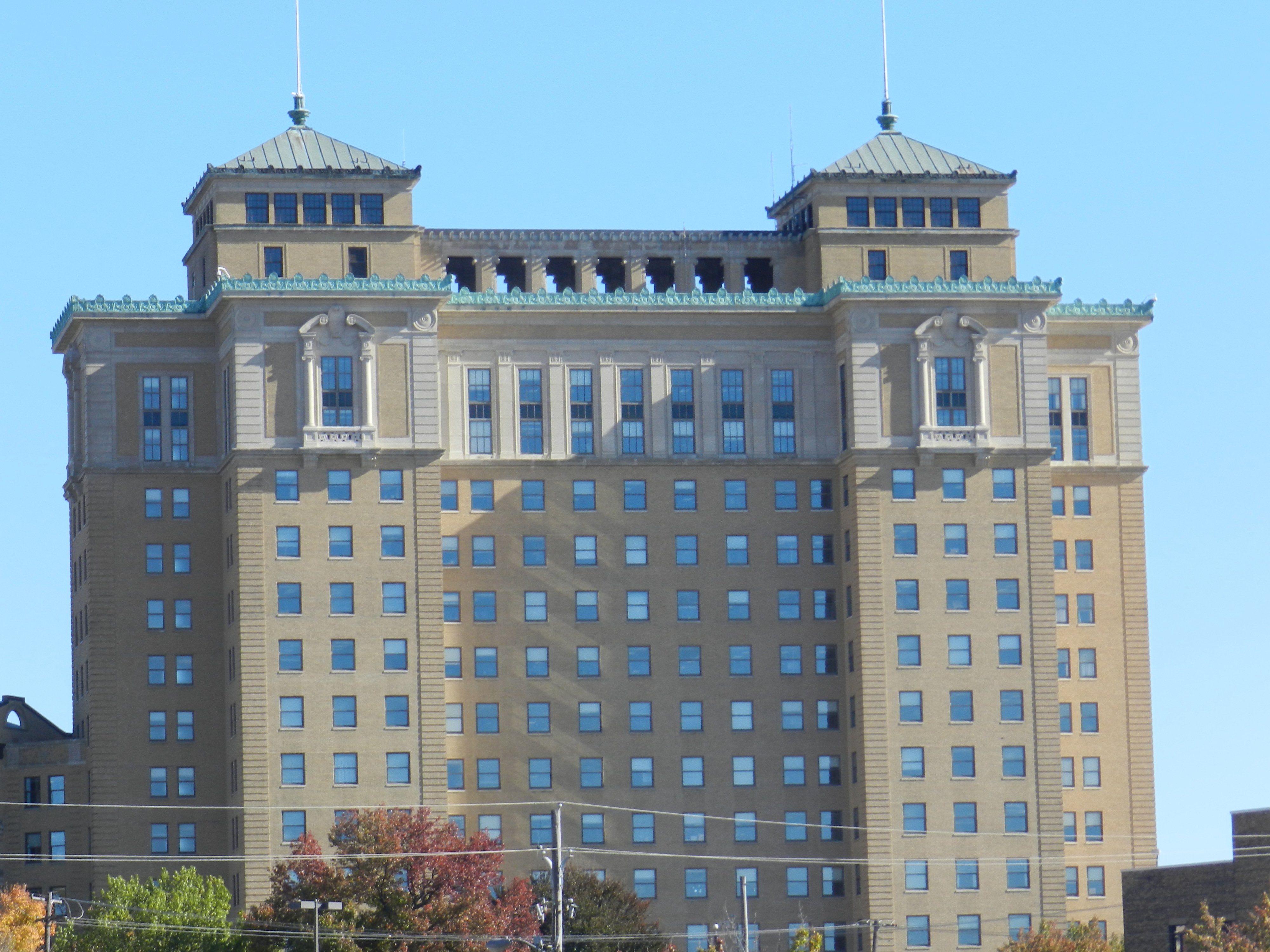
The former Battle Creek Sanitarium, where the devout Kellogg brothers got their start -- John by promoting his "legendarily nutty" wellness diets and therapies, Will by founding a cereal empire. The sanitarium fell on hard times during the Great Depression. During World War II it served as a military hospital. It's now a federal building.
I have been a consumer of American breakfast cereals my whole life long. In fact that’s probably how I first learned to read — with blurry eyes staring at the back of a Kellogg’s Corn Flakes cereal box as the little boy I used to be tried to wake up.
There were always corn flakes in our home, but if I was lucky there’d be a box of Kellogg’s Sugar-Frosted Flakes as well, which I thought tasted a whole lot better.
If you were to ask me then — when I was 5 or 6 — just where it was that Kellogg’s cereals were manufactured, I could have easily told you: It was Battle Creek, Michigan. It was printed very prominently right there on the box.
So I wasn’t surprised at all when some of those long-sunken memories suddenly resurfaced Tuesday while entering Battle Creek on a sunny Michigan morning.
Immediately I thought it might be interesting to take a visitor’s tour of the still flourishing Kellogg’s plant. It wasn’t just some artifact out of the past. Since the days of my childhood, Kellogg’s had prospered exponentially and expanded around the world.
Researching the subject quickly during a breakfast stop, I learned (online from Wikipedia using Kellogg Company documents as source material) that it currently produces more than 60 brands of cereal. Old standards like Corn Flakes, Rice Krispies and All-Bran are still around, as are Sugar Frosted Flakes (the word “Sugar” having been deleted from the title, if not the product itself, back in 1980, as America grew much more health conscious).
 Kellogg products, which also include such notorious tantalizers as Pop Tarts, Cheez-Its and Eggos (when you inevitably pour on the butter and syrup) aren’t just manufactured in Battle Creek and sold to Americans anymore. As the largest cereal producer in the world, with more than $13 billion in sales in 2008, their products are now manufactured in more than 19 nations and marketed in more than 180 countries around the world.
But the managment, if not all the money, ultimately comes back to Battle Creek, which remains Kellogg’s global headquarters. In this day and age, when most of what we buy comes from somewhere other than America, I thought again that touring the plant might be enlightening.
In fact I’d done so once before, years ago, when I was courting a young Michigan girl and spending time with her family. The Kellogg’s of Battle Creek tour we took back then had some of that openness and innocence of a time gone by, with no effort at all to hide raw assembly line procedures that today might make a corporate-lawyer wince.
As I recall we all left the plant cheerfully with sacks full of an assortment of those little Kellogg’s mini-cereal boxes, which they said you could open on the perforated line right down the middle and use just like a cereal bowl. I wondered if I’d get some again.
But no, I wouldn’t. In fact I wouldn’t even get inside.
 “We don’t have tours for the public anymore,” a spokesman outside the headquarters office told me. “We used to long ago, but now we don’t.”
Then before I had a chance to ask him why they don’t, he slipped back into the office. Which left me at a loss for a moment. I’d done all that nice prep work. Now it would come to naught. And I was really looking forward to the pictures.

So instead I took a few shots from outside the fencing, where a train was presently parked with no fewer than 12 empty rows of train tracks along side it — for days, I suppose, when either raw corn, or corn syrup, or high fructose corn syrup, or chemicals I’ve never even heard of before just couldn’t be delivered fast enough.
That’s when I recalled reading Michael Pollan’s really excellent book that documents the American food industry and the way we eat, entitled “The Omnivore’s Dilemma” — in which he particularly takes to task the U.S. emphasis on producing so much corn AND U.S. households for consuming so many processed, sugary by-products of corn. Like the high-fructose corn syrup that Kellogg’s adds to so many of its cereals.
Pollan especially found fascinating the beginnings and eccentricities of the two original Kellogg brothers, raised in Battle Creek as Seventh Day Adventists. They’d worked together in the decades after the Civil War at the huge Battle Creek Sanitarium, a kind of early-day health spa based on the clean-living principles of their church. John Harvey Kellogg was the superintendent and William Keith Kellogg was the bookkeeper.
John would be remembered (at least by Pollan) for attracting thousands of patients a year to his “legendarily nutty” sanitarium to undergo America’s very first fad diet, consisting of nothing but grapes and yogurt (the latter administered to the digestive tract both fore and aft, so to speak, to battle the bacteria that Kellogg believed was generated from eating too much meat) — along with near-hourly enemas.
Will was focused more intently on the cereal company the two brothers launched as a sidelight in the 1890s. They’d had a falling out over that. Will wanted to start adding sweeteners to the cereal. John was opposed. Eventually Will took sole control of the cereal enterprise and added the sugar. And the rest, as they say, is history.

 Travels with Harley
George — the Sanitarium picture is phenomenal!–I love the fact that you somehow got the sky to match the windows and filigree. Simply beautiful. But I write for another, more important reason. Steve McQueen’s 1949 Triumph Trophy TR5 (featured in The Great Escape’s motorcycle-jump scene) is going to be auctioned off on November 12. Thought you oughta know. Stay away from those cross-winds….c.