

"Mentor" by Jane DeDecker -- public sculpture, University of Mississippi
First, the back-story.
While touring the country with his dog and truck a half century ago, John Steinbeck’s journey around America finally hit a kind of emotional wall in the Deep South, where he witnessed firsthand the forced integration of two public schools in New Orleans. It wasn’t pretty.
What they were trying to do that fall of 1960 — six years after the U.S. Supreme Court (in its pivotal Brown v. Board of Education decision) outlawed segregated public schooling in America — was simply allow four small African-American girls to enter the first grade in two all-white public schools. That was it.
Maybe you’ve seen American artist Norman Rockwell’s iconic illustration showing one of them, 6-year-old Ruby Bridges in her shining white dress, walking to school amid a phalanx of federal marshals, a tomato someone had thrown dripping off the wall.
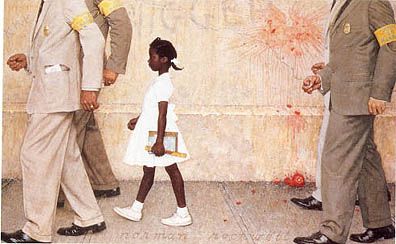
And the tomatoes weren’t the only things thrown. White protesters lined the front of Ruby’s school for weeks shouting insults. They did the same for the other girls attending a different school.
A group of white mothers who’d become known in the media as “the cheerleaders” were especially vile in their taunts. One of them joked about poisoning Ruby’s food (and school officials took the threat seriously enough that they wouldn’t allow the first-grader to eat anything at school that she didn’t bring from home). Another woman brought to the protests a little wooden coffin that had a black doll inside (and later Ruby would write that the dead doll scared her more than anything else).
But the nastiest taunts of all, Steinbeck said, seemed to be reserved for the one or two white parents who continued to bring their first-grade kids to school when all the other white parents wouldn’t. And when one such father walked his son to the schoolhouse door, the cheerleaders went wild.
“No newspaper had printed the words these women shouted,” Steinbeck wrote in Travels with Charley. “It was indicated that they were indelicate, some even said obscene…. But now I heard the words, bestial and filthy and degenerate….”
 The whole experience so disturbed the Nobel-Prize-winning author that once he returned to the road he suddenly found himself rushing toward his journey’s finish line more than a thousand miles away in New York City. And there his Travels with Charley (published two years later) abruptly concluded.
But civil unrest over efforts to desegregate schools in the Deep South lingered on, most famously in Oxford, Mississippi — where two years later James Meredith tried to become the first African-American to enroll in the all-white University of Mississippi. He knew it wouldn’t be easy. But if little Ruby brought out the worst in the local women of New Orleans, Meredith, a military veteran who’d previously studied at Jackson State, seemed to have the same effect on the local men of Oxford.
For two days they rioted on campus in demonstrations that frequently turned violent. According to a follow-up report in Time magazine, 160 federal marshals were injured in the riots, 40 U.S. soldiers were wounded and two people were killed. One of them was French journalist Paul Guihard, who was shot in the back near the steps of the oldest building on campus.
So, that was then.
Fifty years later, here’s what I found as I rode my motorcycle down the very center of the campus at Ole Miss: The most peaceful and pastoral scene you could possibly imagine, partly because the campus was almost empty. It was the day before Thanksgiving. Most of the students had fled the university the day before to celebrate the holiday at home. But remnant signs of the world they now inhabit there were all around. Quite literally.
On the huge electronic-light billboard on the side of the football stadium on campus was the image of a black basketball star in a promo for an upcoming game. In a window of a sports shop nearby was a photo of this year’s Ole Miss football team, in which the overwhelming majority of the players today are black.
I ventured inside the store. It was nearly empty, but two female student employees — one white and one black — were chatting amiably about world literature. The black girl was recalling how, in the high school she attended, she had to memorize and recite before her whole class the “Prologue” to Canterbury Tales — in the original Middle English.
“Whan that Aprill with his shoures soote/ The droghte of March hath perced to the roote…”
I’d previously read how Ole Miss today has a fair share of English majors and promising writers, and these two students seemed to fit the bill. Part of the attraction of Ole Miss, of course, is the fact that Oxford was the hometown of the great American writer William Faulkner, who turned it into the fictional “Jefferson” of “Yoknapatawpha County” in several of his novels.
The university also has one of the top law schools in the country. And its said only half-jokingly that everyone in town today is either a writer, or a lawyer — or both.
Outside again, I walked through “The Grove” of oaks that serves as the heart of campus. A path down the middle leads to “The Lyceum,” with its classic Greek columns, the oldest building on campus. It’s said that its columns are still marred by the bullet holes of the shots that were fired back in 1962 when James Meredith tried to walk through its doors.
Now there’s a bronze statue of Meredith near the front of the building commemorating the college’s first African-American student. And nearby is a plaque — put there by the class of 2005 — that enshrines “The Ole Miss Creed.” It says the university today is dedicated to nurturing excellence in intellectual inquiry “in an open and diverse environment.”
Moreover:
As a voluntary member of this community: I believe in respect for the dignity of each person. I believe in fairness and civility. I believe in personal and professional integrity. I believe in academic honesty. I believe in academic freedom. I believe in good stewardship of our resources. I pledge to uphold these values and encourage others to follow my example.
A creed even Faulkner would have welcomed.

 Travels with Harley
‘Been waiting for “the rest of the story.” Thank you George.
Hi Susie! Glad you found it interesting. Thanks!
George,
Thank you for the moving post. I don’t know that I have ever so enjoyed a series of articles.
Thanks Jona! Glad you found it interesting. Maine seems a long ways away to me right now, as I work my way across Texas. Thanks for putting me up as I “turned the corner” to head south. Good memories there in Robert Frost land. Cheers!
The James Meredith case at Ole Miss is still remarkable to read about. (So is the integration of the two schools in New Orleans.) The America of 50 years ago–I know I grew up in it but I do not recognize it! … I didn’t know about the French journalist until now. It’s easy to imagine he was deliberately shot from behind by Klansmen or someone in their camp. … So Faulkner died in July 1962, a few months before Meredith entered Ole Miss. He missed seeing the campus as a war zone. You have to wonder what he’d have thought of that. He famously said (in an interchange with James Baldwin) that the South should not be forced to integrate; such changes needed to happen on their own clock. … Meredith is apparently still alive. Next year is the 50th anniversary of those events. Will he attend whatever ceremonies they have at the university?
Peter, good points. I wondered the same thing about Faulkner. I think he would have known that James Meredith was coming, because the governor of Mississippi was battling President Kennedy over integration in the press (and Atty. Gen. Bobby Kennedy made news, too, ultimately sending in 500 federal marshals). I didn’t know about Faulkner’s comment to Baldwin. Very interesting. I did, however, find inspiring his acceptance speech upon receiving the Nobel Prize for literature, when he said:
“I believe that man will not merely endure: he will prevail. He is immortal, not because he alone among creatures has an inexhaustible voice, but because he has a soul, a spirit capable of compassion and sacrifice and endurance. The poet’s, the writer’s, duty is to write about these things. It is his privilege to help man endure by lifting his heart, by reminding him of the courage and honor and hope and pride and compassion and pity and sacrifice which have been the glory of his past. The poet’s voice need not merely be the record of man, it can be one of the props, the pillars to help him endure and prevail.”
Fascinating story and a beautiful campus. I’ve always wanted to explore down in the Deep South. Thanks for sharing the stories and the pictures. 🙂
Thanks for reading, Liz! And Happy Holidays!
Thank you George for sharing and reminding us of our history. I can still remember seeing James Meredith being confronted at the door as he tried to enter. It’s important to remember in order to ensure history doesn’t circle and repeat its self.
Hi Roger! Jeez. Seems like ages ago that we were rowing a double together in Sydney — and then the wind came up and blew us off the lake. Glad you’re joining me on my current travels. Glad too you found this last piece worthwhile. Cheers!