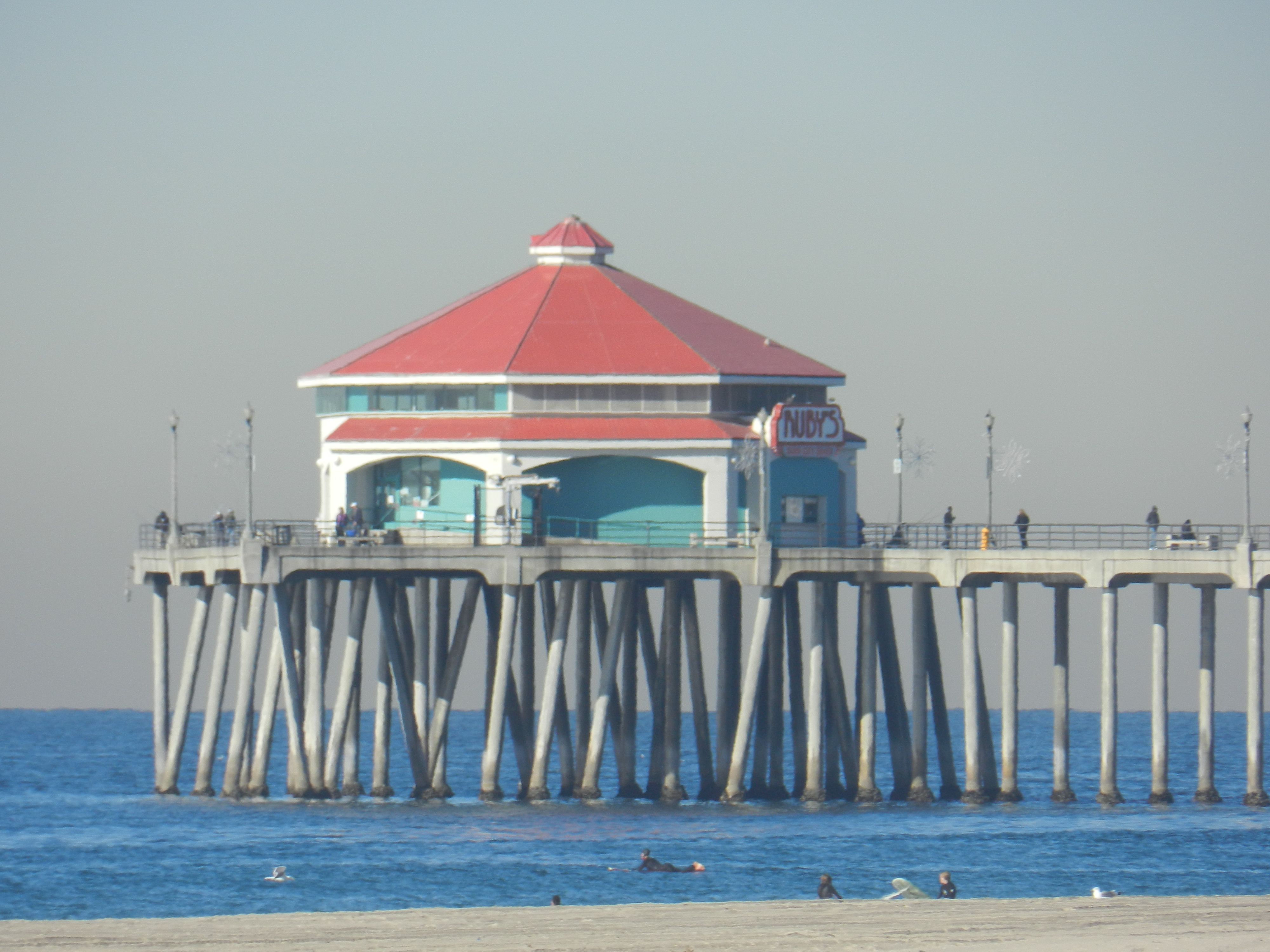
Traveling north, still a few miles short of my hometown, we passed by the old pier at Huntington Beach, where my teenage friends and I sometimes went surfing, sharing one board between us.
Since I wasn’t the board-owner, most of the time I simply body-surfed, but that could be challenging too. Because the swells at Huntington sometimes got big, and when they did, they broke well offshore in fairly deep water. And if you entered the wave too late — or if you failed to pull out when you should have — then things got crazy as the ocean crushed you under its weight, and a powerful gyre whirled you around, and you couldn’t tell which way was up.
That could be kind of funny for the first 20 seconds or so, until underwater your one gulp of air began to run out. Then it wasn’t funny anymore. Then you had to choose a direction that might be toward the surface and really swim for it. And sometimes in doing this you would abruptly ram your head into the sandy seafloor. And that was good in a way. Because at least then you knew you had to go the other direction.
Well, returning to your hometown after a long absence can be a little bit like that: Exciting in the beginning. Turbulent (or at least disorienting) in the middle. Clarifying in the end.
In the 1930s the southern writer Thomas Wolfe wrote a novel titled You Can’t Go Home Again. What he meant by that, I think, is that both you and your hometown have changed in the meantime, so even if you returned it wouldn’t be the same.
On this journey, however, I approached the same predicament more literally. I really couldn’t go home again, because — for the first time in my life — my family no longer owns the Long Beach house I grew up in. We sold it last year after my mother passed away at the age of 94.
Neither of my parents went to college. They worked with their hands all their lives. In the heart of the Great Depression — shortly after they married in Long Beach in 1935 — my dad taught himself how to be an upholsterer and eventually owned his own shop. As soon as he could, he taught his sons to help him.
My older brothers and I grew up in my dad’s shop, tearing apart old furniture, salvaging the stuffing, repairing the frames, retying the springs, tacking on burlap and cambric linings — and more or less doing everything short of the actual measuring, cutting, sewing and upholstering of expensive fabrics that required my father’s skill.
Before the war ended and before I was born, my parents bought a large cottage — actually an old YWCA clubhouse with a huge fireplace and massive living room with old wrought-iron Spanish chandeliers hanging from the ceiling — then embarked on a long struggle to make the $25 mortgage payment each month.
But in that modest two-bedroom house (my brothers and I actually slept in the unattached remodeled garage we called the bunkhouse) they raised five children. And from that house we could walk to all the schools we attended. My elementary school stood nine blocks away. My junior high was six. My high school across the street.
There was a long block of athletic fields that separated our house from the actual high school, and my life was shaped by those fields. I could play football and baseball and tennis there year around. And in the high school was a pool where we all learned to swim. And one block beyond that was a public golf course, where you could sneak on around dusk for free.
Next to the golf course was a huge park with towering pines and fragrant eucalyptus trees and a Spanish mission styled amphitheater where starlight concerts and public picnics were held each summer. And beyond the golf course was a salt-water estuary dredged out of the shoreline to host the rowing events for the 1932 Olympic Games — where we all learned to water-ski. And beyond that was the ocean and Catalina Island and fishing in the open sea.
So, as you can see, even for working-class kids like us, we had it awfully good in the 1950s, ’60s and ’70s. And that’s because “Where I Came From” has an economic dimension as well. There was a burgeoning middle-class all across America back then, primarily because of the government policies advanced by Presidents Roosevelt, Truman, Eisenhower, Kennedy and Johnson.
The words “stimulus spending” hadn’t been coined just yet, but all the government borrowing and spending that occurred during World War II and immediately afterward would make anything that President Obama and the Democrats have proposed look timid and paltry by comparison. Taxes were much more progressive back then. That means the rich paid a far greater share than they do now.
So with all that tax revenue and government spending, people were put to work building the roads and public schools and parks I grew up with. And since jobs were much more plentiful — thanks again to government spending — the economy grew and everyone did better. Even the rich. In fact it grew so much it was easy for the government to pay off its debts.
Like I was saying, a trip back home can sometimes clarify a few things.
Before this one was over, my sister and I got to place fresh flowers on our parents’ grave. I rode Harley to the old house and took some pictures. We circled my high school and the nearby park, and then I rode past my old elementary school — where they were still teaching kindergarten in the same room where I attended kindergarten, and the current teacher gave me a tour. I rode Downtown to see the Christmas decorations, took one last glimpse at the ocean — then my motorcycle and I continued on our way.

 Travels with Harley
Wow, great remembrance of a place that is a slice of home for me too. We look forward to seeing you in a few days!
Thanks, Pat! Looking forward to seeing you too. Here’s my new ETA: Sunday evening. My return flight home is Monday afternoon. Cheers!
George, I loved tagging along vicariously on your journey and enjoyed every entry in your blog. However, this was by far my favorite post. What a wonderful place to grow up, and what a wonderful tribute to it and to your parents.
Thanks, Julie. That’s really nice to hear. You’re doing a pretty great job of parenting yourself, from what I can tell (as apparently your parents did before you). Way to go, “Connor’s Mom”!
Brent has been sharing these travel commentaries with me. I love them, but especially this one. It brought a tear to my eye. And brought back some similar memories.
Thank you, Nancy! If it’s any consolation it brought a tear to my eye too… / Cheers!
Thank you for Tuesday and for spending your birthday with me (and Aunt June’s and Daddy’s and Kathleen’s) and for this remembrance of what at times I recall as almost an idyllic life our parents provided us. The pictures are as powerful as the words that so beautifully describe them (I have always loved the one of you in Dick’s marine hat–I remember the joy, the hope and then the anguish that followed so vividly) I am thankful that you are at Bernie and Char’s finally and then almost home–continue to be safe, dear George. Love, Lynda
Thank you, Sis! Finally made it across the finish line, and of course I never could have done so without the support of my family, including my former dish-washing partner. So — thanks! And all the joy of Christmas to you and Tom & all the wandering Wind clan! / Love, George
Hey Harley,
I finally had an opportunity to check out your “travels” and find them fascinating. I am extremely honored to be mentioned! It was truly a pleasure chatting and giving you a “tour” around John C. Fremont’s Kindergarten. Happy New Year! I hope 2012 brings you many more happy journeys.
Hugs,
Donna Ruggles
Thanks, Donna. It was fun peeking in on my old kindergarten classroom — and finding out that it’s still a kindergarten classroom after all these years (albeit a much more advanced one than mine). Since I eventually married a kindergarten teacher (among her many other attributes), I know how hard you work and what a profound effect you can have on the lives of beginning students. Thanks for sharing your time with me! Cheers! / George